Case Study
AI Automation - Driving ROI in the modern world
Delivering successful AI solutions requires more than technology; it demands a clear understanding of both business processes and the people who rely on them. That is where PTR Associates can help.


Introduction: Tackling High-Volume Service Demand with Intelligent Automation
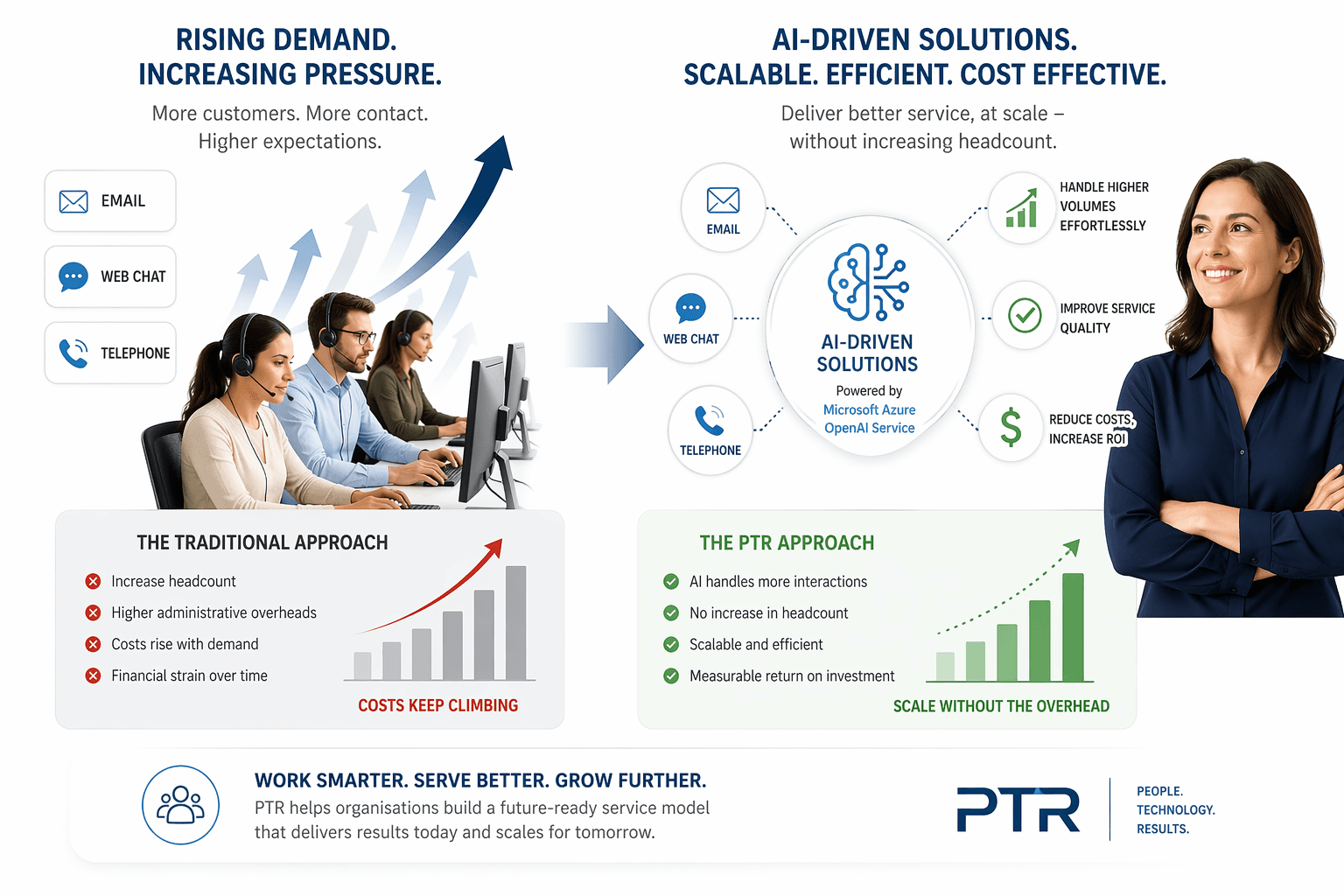
As organisations grow, so do the expectations and demands of their customers. This is especially true for service-based organisations, where rising volumes of contact across email, web chat, and telephone channels place increasing pressure on teams to respond quickly and effectively.
The traditional response has been to expand administrative functions and increase headcount to manage this demand. While this can provide short-term relief, it creates a cost model where growth in service demand is directly tied to growth in staffing. Over time, this approach leads to significant financial strain, with administrative overhead becoming an increasing burden on the organisation.
PTR supports organisations in moving beyond this model. By delivering AI-driven solutions built on platforms such as Microsoft Azure OpenAI Service, PTR enables businesses to manage higher volumes of demand without a corresponding increase in headcount. This creates a more scalable and efficient operating model, reducing costs while improving service quality and delivering measurable return on investment.
Case Study : The Housing Association Scenario

Housing associations provide a clear example of how high volumes of customer interaction can drive significant administrative cost. Every day, thousands of tenants make contact through email, web chat, and telephone, creating a constant demand for timely and accurate responses.
Much of this process relies heavily on the experience and knowledge of administrative staff. As a result, service quality can vary depending on individual expertise, and the effort required for training and onboarding continues to grow. Teams are often required to interpret queries, determine relevance, and guide tenants toward the appropriate outcome, all while managing high workloads.
A large proportion of daily interactions are routine or misdirected. Many involve requests that fall outside the services provided by the housing association, yet still require time and effort to assess and respond. This makes effective triage essential, but also increasingly difficult. As volumes grow, the risk of delays, inconsistencies, and errors rises.
These challenges are compounded by disconnected systems and inconsistent record-keeping. Without a single, unified view of tenant interactions, information can be duplicated, lost, or incomplete, making it harder for staff to resolve issues efficiently.
While this scenario is common within housing, it reflects a broader challenge faced across many public-facing sectors, where rising demand, fragmented systems, and reliance on manual processes create ongoing operational strain.
Reimagining First Contact with Azure OpenAI
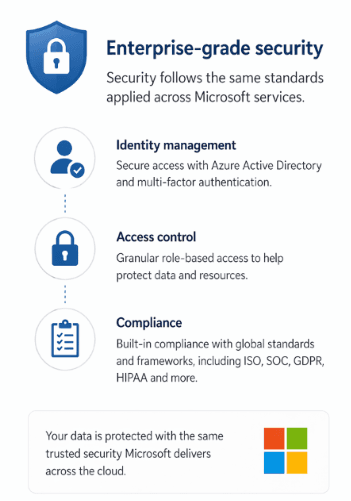
Microsoft Azure provides access to OpenAI services within your own environment. Unlike many AI platforms, all communication with the service is isolated to your subscription. Your data remains within your tenant, is not shared externally, and is not used to train public models.
Security follows the same standards applied across Microsoft services. This includes identity management, access control, and compliance with established frameworks. The platform also uses a consumption-based pricing model, allowing you to control costs based on actual usage.
The OpenAI agent enables more advanced interactions than traditional systems. It can hold contextual conversations and adapt as the situation changes. Unlike rule-based systems that rely on fixed decision trees, the agent evaluates inputs in real time, makes decisions, and responds accordingly.
This approach supports more complex use cases and reduces the need for rigid logic that often fails in unpredictable scenarios.
By adopting this approach, the housing association can delegate initial triage to an intelligent agent. When a call, email, or web chat is received, the agent captures key information, understands the customer’s issue, and routes the request to the appropriate member of staff.
This triage process ensures accurate routing, gathers all required details upfront, and reduces the time staff spend clarifying issues. Interactions are automatically logged within the CRM, eliminating the need for manual updates and ensuring a complete audit trail.
The result is a more efficient service operation, where staff focus on resolution rather than administration. This improves response times, enhances customer experience, and reduces overall operational costs through increased efficiency.
Building an Intelligent Front Door
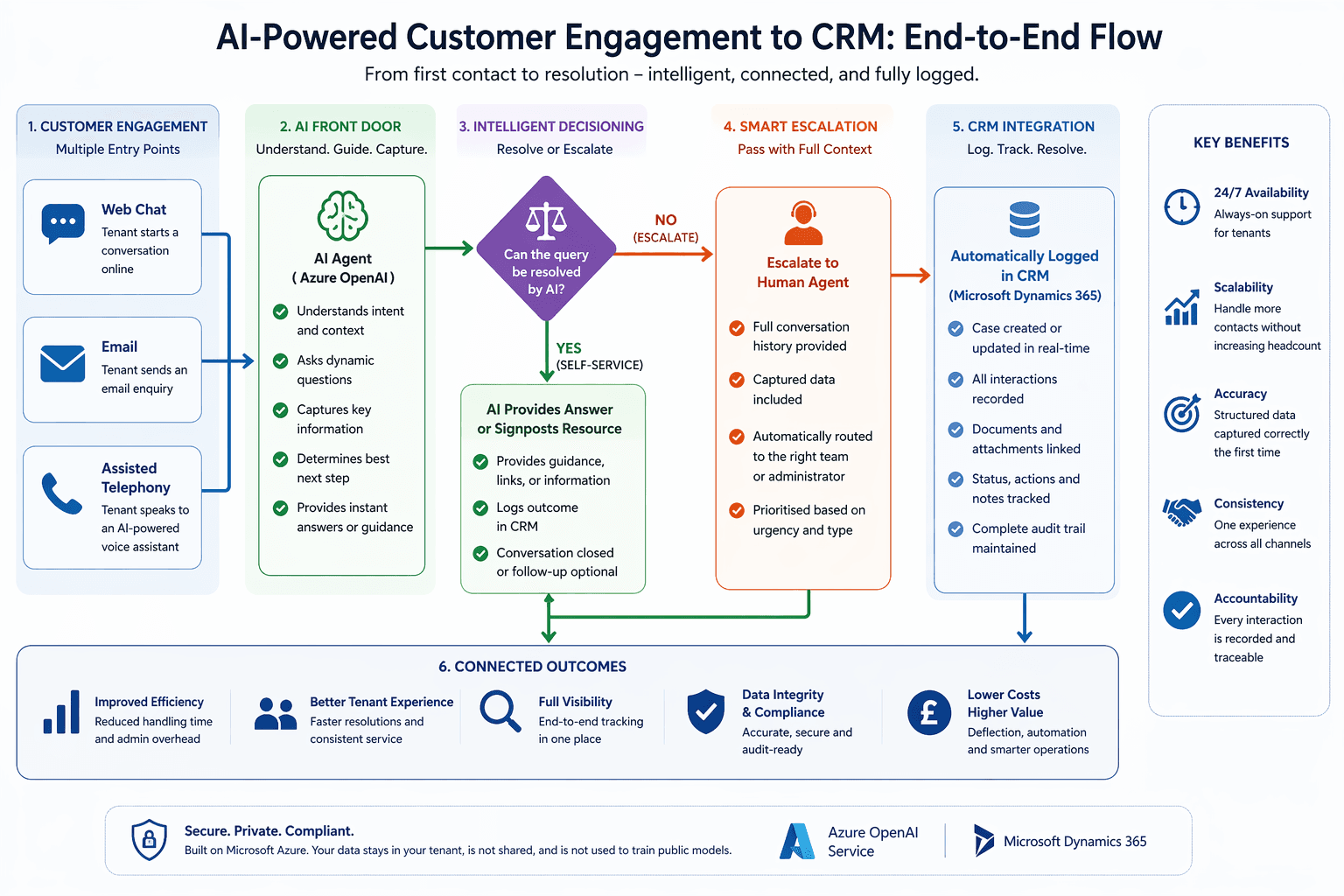
Building an Intelligent Front Door shifts the point of entry from a passive reception channel into an active, decision-making layer within the organisation. Instead of simply receiving queries, the front door becomes responsible for understanding intent, validating relevance, and shaping the interaction in real time. Whether a tenant engages via web chat, email, or an assisted telephone journey, the experience is unified and consistent, removing the fragmentation that typically exists between channels. The AI does not just respond, it interprets, guiding users through structured conversations that naturally capture the information required for resolution. This ensures that from the very first interaction, data is standardised, contextual, and immediately usable, laying the foundation for downstream processes to operate with far greater speed, accuracy, and efficiency.
Capturing the Right Information
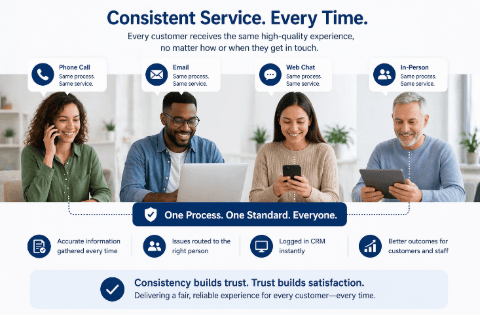
Capturing the Right Information and Storing It Instantly is where the real operational value begins to materialise. Rather than relying on static forms or incomplete user inputs, the AI dynamically adapts its questioning based on context, ensuring that only relevant, high-quality information is gathered. Each response is interpreted, validated, and structured in real time, transforming unstructured conversation into clean, consistent data. This removes the ambiguity that often leads to rework and delays, while also eliminating the need for manual transcription by administrative teams. Crucially, this information is not held in isolation. It is written directly into core systems at the point of interaction, ensuring that every enquiry immediately becomes part of the organisation’s operational dataset. The result is a significant improvement in data integrity, faster downstream processing, and a foundation that supports accurate reporting, automation, and informed decision-making from the outset.
Because the housing association maintains a complete history of customer interactions within its CRM, triage decisions can be informed by previous conversations. This provides valuable context, allowing the organisation to respond consistently and accurately.
By leveraging this history, the system can identify when an issue has already been resolved and prevent unnecessary repeat enquiries. This reduces the risk of customers attempting to obtain a different outcome by contacting multiple agents.
The result is a more consistent service, improved decision-making, and reduced operational overhead, while ensuring customers receive clear and fair responses based on their full interaction history.
Smart Escalation ensures that instead of passing on fragmented notes or requiring tenants to repeat themselves, the AI compiles a complete, structured case that includes the full conversation history, captured data points, and an understanding of intent. This enriched context is then used to route the case intelligently, directing it to the most appropriate team or individual based on factors such as issue type, urgency, and workload. For administrators, this removes the need for initial triage and allows them to focus immediately on resolution. It also reduces handling time, improves consistency, and minimises the risk of errors or misinterpretation. In effect, escalation becomes a continuation of the process rather than a reset, preserving momentum and ensuring a smoother experience for both the tenant and the organisation.
Operational Impact and Efficiency
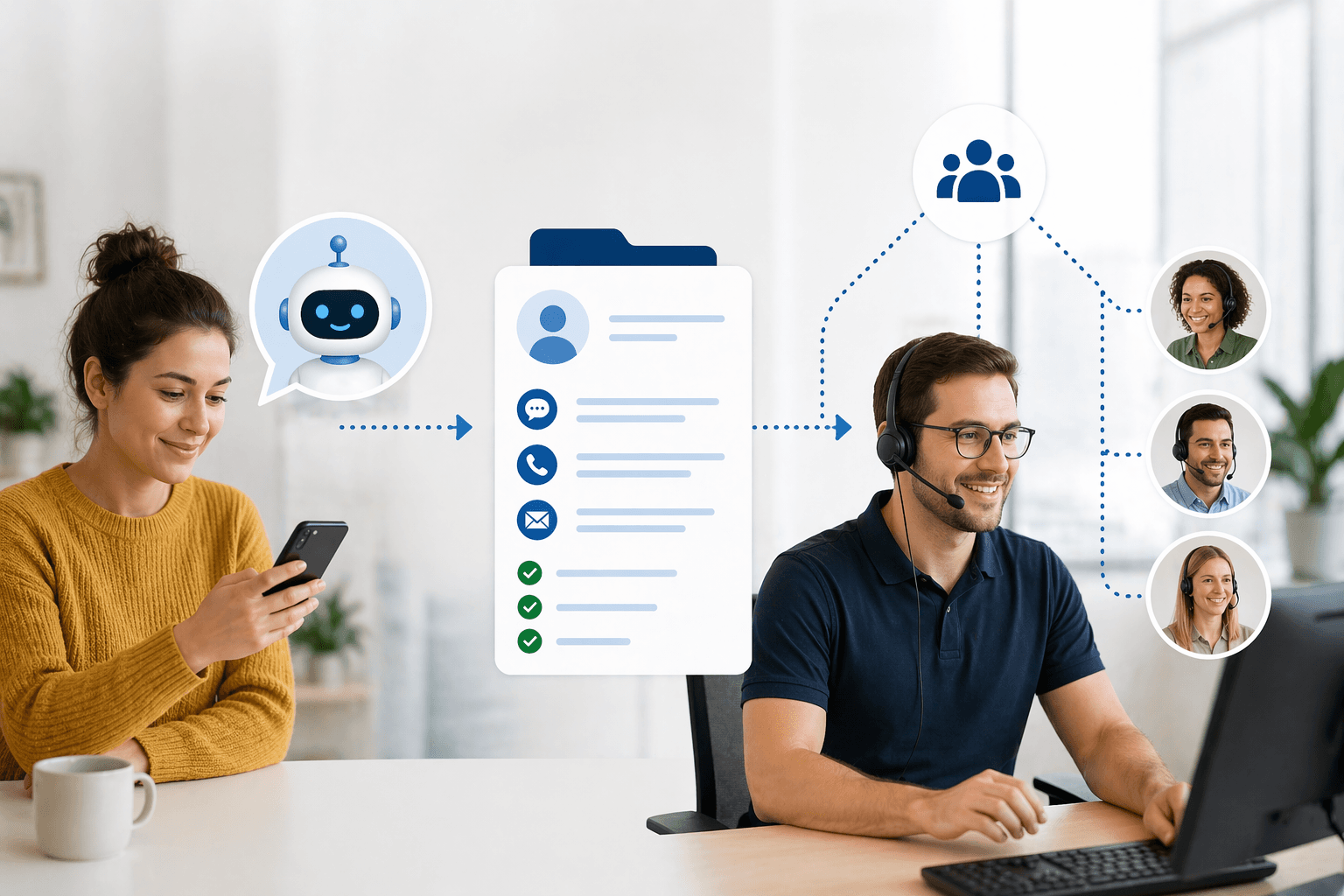
Efficiency Through Integration is where the cumulative benefits of the approach become visible across the organisation. By connecting AI-driven engagement directly with core systems, manual handoffs and disconnected processes are removed entirely. Information flows seamlessly from first contact through to resolution, with each step building on structured, reliable data captured at the source. This significantly reduces administrative overhead, as tasks such as logging, categorisation, and status updates are handled automatically rather than by staff.
At an operational level, this creates a more responsive and coordinated environment. Teams are no longer working from partial information or siloed systems, but from a shared, real-time view of activity. This improves case tracking, strengthens accountability, and enables more accurate reporting without additional effort. Over time, the organisation benefits from a cleaner dataset, more efficient workflows, and the ability to scale service delivery without introducing additional complexity or cost.
Return on investment (ROI)
Return on investment is ultimately driven by the ability to break the long-standing link between service demand and staffing levels. By reducing unnecessary contact through intelligent deflection and improving the efficiency of interactions that do require escalation, organisations begin to see measurable reductions in cost per case. These gains translate into short and clearly defined payback periods, often realised through a combination of lower call volumes and reduced handling times. As demand continues to grow, the model scales without the need for proportional increases in headcount, allowing organisations to absorb higher volumes while maintaining control over operational costs. Over time, this creates a more stable and predictable cost base, where efficiency is built into the process rather than dependent on continual resource expansion.
How PTR Delivers
Delivering successful AI solutions requires more than technology; it demands a clear understanding of both business processes and the people who rely on them. That is where PTR Associates can help.
Our consultants and developers bring extensive experience in designing and implementing AI-driven solutions alongside Microsoft technologies such as Power Platform and Azure. We work closely with your teams to define scope, identify high-impact opportunities, and deliver solutions that integrate seamlessly with your existing systems while improving efficiency and decision-making.
Beyond delivery, PTR provides structured training, mentoring, and ongoing support to ensure your teams can confidently operate, maintain, and enhance the solution. This approach embeds knowledge transfer throughout the engagement, enabling your organisation to become self-sufficient rather than reliant on external support.
If you are looking to reduce operational overhead, improve service outcomes, and build internal capability, PTR Associates can help you design, deliver, and sustain AI solutions that continue to evolve with your business.
Frequently Asked Questions
Couldn’t find the answer you were looking for? Feel free to reach out to us! Our team of experts is here to help.
Contact Us