
Data Validation Consultancy Services
Catch the bad data before anyone makes a decision on it
The ability to quickly find and fix data quality issues is what makes a repository people actually trust. That means checking every record on every refresh, then acting on whatever fails before it ever reaches a report.

Trust starts with knowing it's right
Most data problems are quiet. A handful of customer records are missing a postcode, a few prices were entered in the wrong currency, the same supplier appears twice under slightly different names, and a date that should never be in the future somehow is. None of it stops the data loading. None of it throws an error. It simply sits there, looking exactly like good data, until the day a report built on it tells someone the wrong thing.
By the time a wrong number surfaces in a board pack or a customer letter, the damage is already done and the trail back to the cause is cold. People start sense-checking every figure by hand, and the whole point of having a single source of data, that you can rely on without re-checking, quietly evaporates. Confidence is hard to win back once it has gone.
Data validation is the discipline of checking data against the rules it is supposed to obey, every time it arrives, and dealing with whatever fails before it flows downstream. You notice it most by its absence of drama: the figures are simply right, exceptions are caught and handled early, and people get on with using the data instead of interrogating it. That dependable quality is what turns a data store into a source of truth.
What are your challenges?
You have probably met most of these already. Records turn up with key fields left blank, so a report silently drops customers or undercounts a total. The same entity is entered more than once in subtly different ways, and figures get double-counted as a result. Values appear that simply cannot be true, a negative quantity, an age of two hundred, an email with no @ in it, yet nothing stops them being saved.
Formats wander as well, with dates, currencies and reference codes recorded differently depending on who typed them or which system they came from, so like is never quite compared with like. And because nothing checks any of this automatically, the problems are usually discovered far too late, when a figure in a finished report looks wrong and someone has to work backwards to find out why.

"You only find out you trusted bad data after you've acted on it."
How can PTR help?
We start by profiling your data to see what is really there, how complete each field is, where duplicates hide, which values fall outside sensible limits, and how consistently things are recorded. That profile tells us where quality is genuinely at risk, rather than guessing, and gives us the basis for the rules worth checking.
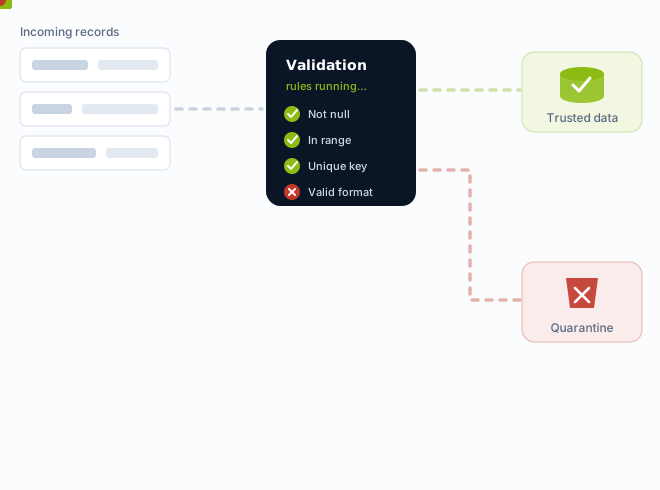
From there we turn the processes where your data must always be true into automated checks that run every time the data refreshes, not as an occasional manual audit. Records that pass flow straight through; records that fail are flagged, set aside for review and never silently pollute the trusted set. The whole picture, an overall quality score, a breakdown by dimension, the trend over time and exactly which checks are failing, is shown on a dashboard so issues are caught the moment they appear and can be fixed at source.
Because the checks are built into the data's normal path and monitored, quality stops being a periodic firefight and becomes something you can see and rely on. All of it sits on the tools you already run, and we either operate it for you or coach your team to own it.
Where do you start?
We usually open by profiling the data you already hold and agreeing what good looks like for the fields that matter, so the checks we build reflect the rules your business genuinely depends on.
Frequently Asked Questions
Couldn’t find the answer you were looking for? Feel free to reach out to us! Our team of experts is here to help.
Contact Us