
Microsoft Fabric
A Toolbox, not a Moving Van: What Microsoft Fabric Actually Asks You to Change
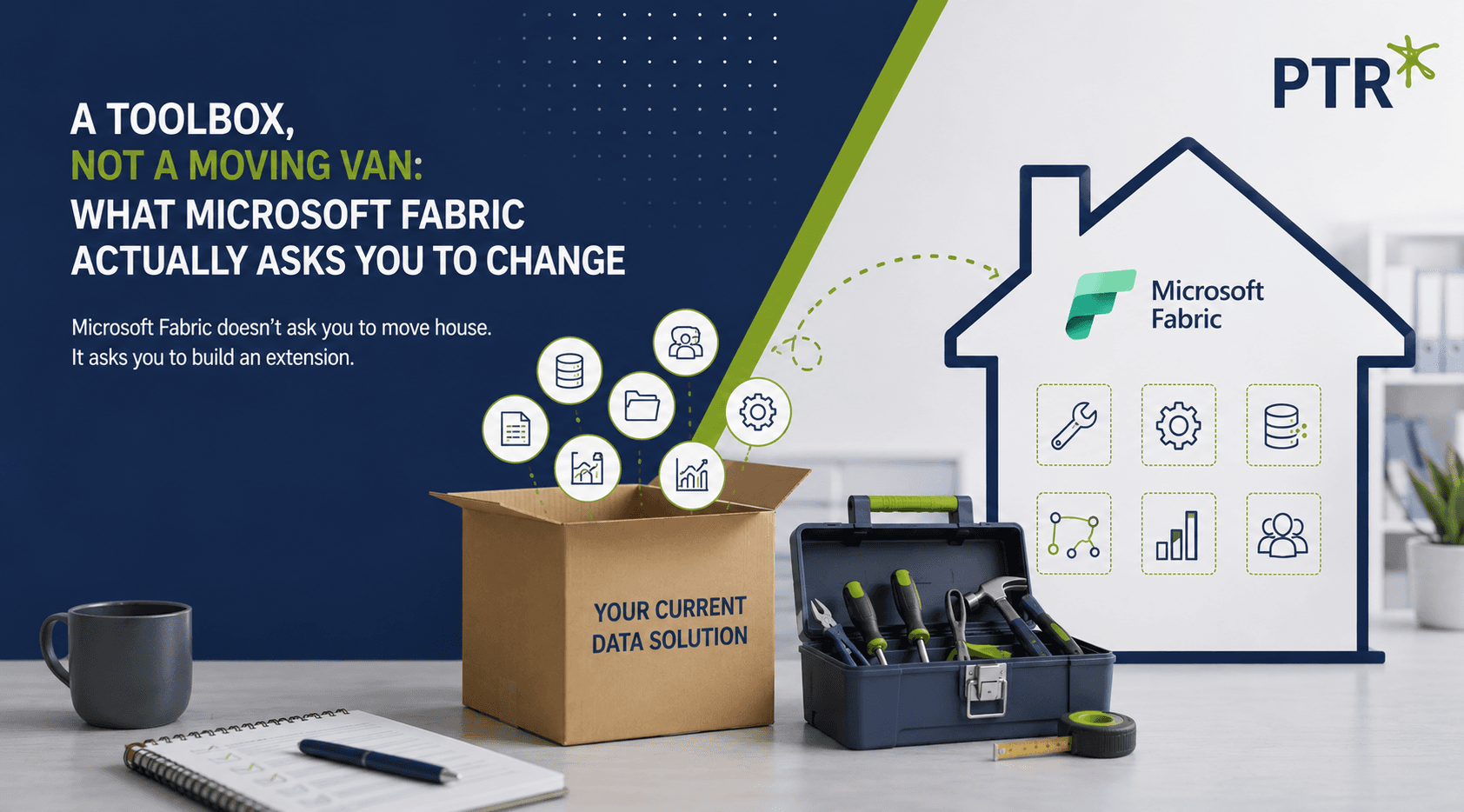
Microsoft Fabric doesn't ask you to move house, it asks you to build an extension.

A Toolbox, Not a Moving Van: What Microsoft Fabric Actually Asks You to Change
When people hear "new data platform," they usually picture the same thing: months of planning, a small army of consultants, and a nervous wait while everything gets packed up, moved, and unpacked somewhere else. That's migration — and it's exactly the kind of big-cost, big-risk, big-commitment project that keeps getting pushed to "next year."
Microsoft Fabric doesn't ask you to move house. It asks you to build an extension.
Think of Fabric as a toolbox rather than a removal van. You don't need every tool out of the box on day one — each one is useful on its own, works with what you've already got, and adds value the moment you pick it up. Here's what's actually inside.
OneLake: a map, not a warehouse
The instinct with any new platform is to assume all your data has to move into it first. OneLake doesn't work that way. It's a logical layer, not a physical one — think of it less like a warehouse where every item has to be shipped in and re-shelved, and more like a single master directory that already knows exactly where everything sits, wherever it currently lives. You get one simplified point of access to your data without a single ETL job or migration project standing in the way.
Why it matters: for the business, that's the difference between "we can start reporting on this next quarter" and "we can start reporting on this next week." For the technical team, it's one entry point instead of a dozen separate connections to maintain.
Shortcuts: a pointer, not a photocopy
If OneLake is the directory, Shortcuts are how you actually reach the data. A shortcut works exactly like the one on your desktop — it doesn't duplicate the file, it just opens the real, live version wherever it already sits. Nothing moves, nothing is copied, and no new pipeline has to be built and maintained just to keep two versions in sync.
Why it matters: the investment you've already made in your existing systems — Databricks, Synapse, on-premise databases — keeps paying off, because Fabric plugs into it rather than replacing it. No duplicate storage bill, no pipeline to babysit.
Mirroring: a live feed, not a re-typed scoreboard
Some data genuinely does need to be reflected inside Fabric in near real time — and that's what Mirroring is for. Rather than someone manually re-keying figures onto a scoreboard every few minutes, Mirroring keeps a continuous, near-instant replica flowing into OneLake automatically, with no ETL required. Microsoft keeps adding new source systems it can pull from, so the list of what you can mirror keeps growing.
Why it matters: you can report against live operational data — stock levels, transactions, sensor readings — without writing a single pipeline, and crucially, without ever touching or risking the production system it came from.
OneLake Security: one badge, every door
This is the part that tends to worry people most, and reasonably so — connecting more data to more places usually means more ways for the wrong person to see the wrong thing. OneLake Security solves this the way a single building-wide keycard solves the "different lock on every door" problem. One set of rules — down to which tables, which rows, and even which columns someone can see — is defined once and enforced consistently, whether the data was created natively in Fabric, reached through a Shortcut, or brought in via Mirroring. Those rules travel downstream automatically into lakehouses, SQL endpoints, and semantic models, so nothing leaks through a side door. Layered on top, Purview integration keeps a record of where sensitive data lives and how it's labelled, so governance teams can see it as clearly as the data teams can use it.
Why it matters: for IT and security teams, it's one policy to maintain instead of five. For the business, it's the reassurance that opening data up more widely doesn't mean losing control of it.
The point of all four
None of this requires ripping anything out. Each layer earns its keep on its own — you could adopt just OneLake and Shortcuts and already remove a chunk of duplicate storage cost, long before Mirroring or Security ever enter the conversation. That's the real difference between integration and migration: you get value in weeks, in the order that matters to you, using the systems you've already paid for.
A UK example: quick wins alongside a slow migration
Centrica — the UK energy company behind British Gas — is a useful illustration of exactly this pattern, according to a Microsoft customer story published on microsoft.com. At the same time as its Finance team was working through a slow, phased migration off a legacy billing system (the kind of multi-year project that runs old and new systems in parallel), they didn't wait for that migration to finish before getting value from their data. Using Fabric's Shortcuts, they connected to data across their existing ERP, billing, CRM, and industry systems without physically moving or copying it. Arne Richards, Centrica's Finance Systems Manager, put it plainly: "The ability to take Microsoft Fabric and use it immediately with minimal integration has been a real gamechanger for us."
The results were concrete: 45 separate report spreadsheets were consolidated into a single real-time report, and — in the words of Aaron Keddie, Centrica's Finance Global Chief Operating Officer — the team went from "ingesting vast quantities of CSV files into Excel to being able to query billions of rows of data within tens of seconds." The legacy migration carried on in the background; it simply wasn't a precondition for the win.
We'll be unpacking all four of these — with live examples — at our upcoming session, "Microsoft Fabric: Navigating Adoption Blockers and Identifying Quick Wins." Whether you're the one signing off the budget or the one who'll be configuring the roles, there's something in it for you.
Wondering whether to choose a Data Warehouse or Medallion Architecture Lakehouse in Fabric? Check out another of our blogs from one of our consultants: Data Warehouse or Medallion Architecture Lakehouse? What on Earth do I Choose When Moving into Microsoft Fabric?!
Webinar coming in October - register here or get in touch to reserve your space info@ptr.co.uk
MD
Mandy Doward
Managing Director
PTR’s owner and Managing Director is a Microsoft certified Business Intelligence (BI) Consultant, with over 35 years of experience working with data analytics and BI.
Frequently Asked Questions
Couldn’t find the answer you were looking for? Feel free to reach out to us! Our team of experts is here to help.
Contact Us