
Tech Tips
YouTube and AI Helped Me Build It. A Human Helped Me Trust It
Addressing the gap between building solutions with AI, and understanding and trusting solutions built with AI

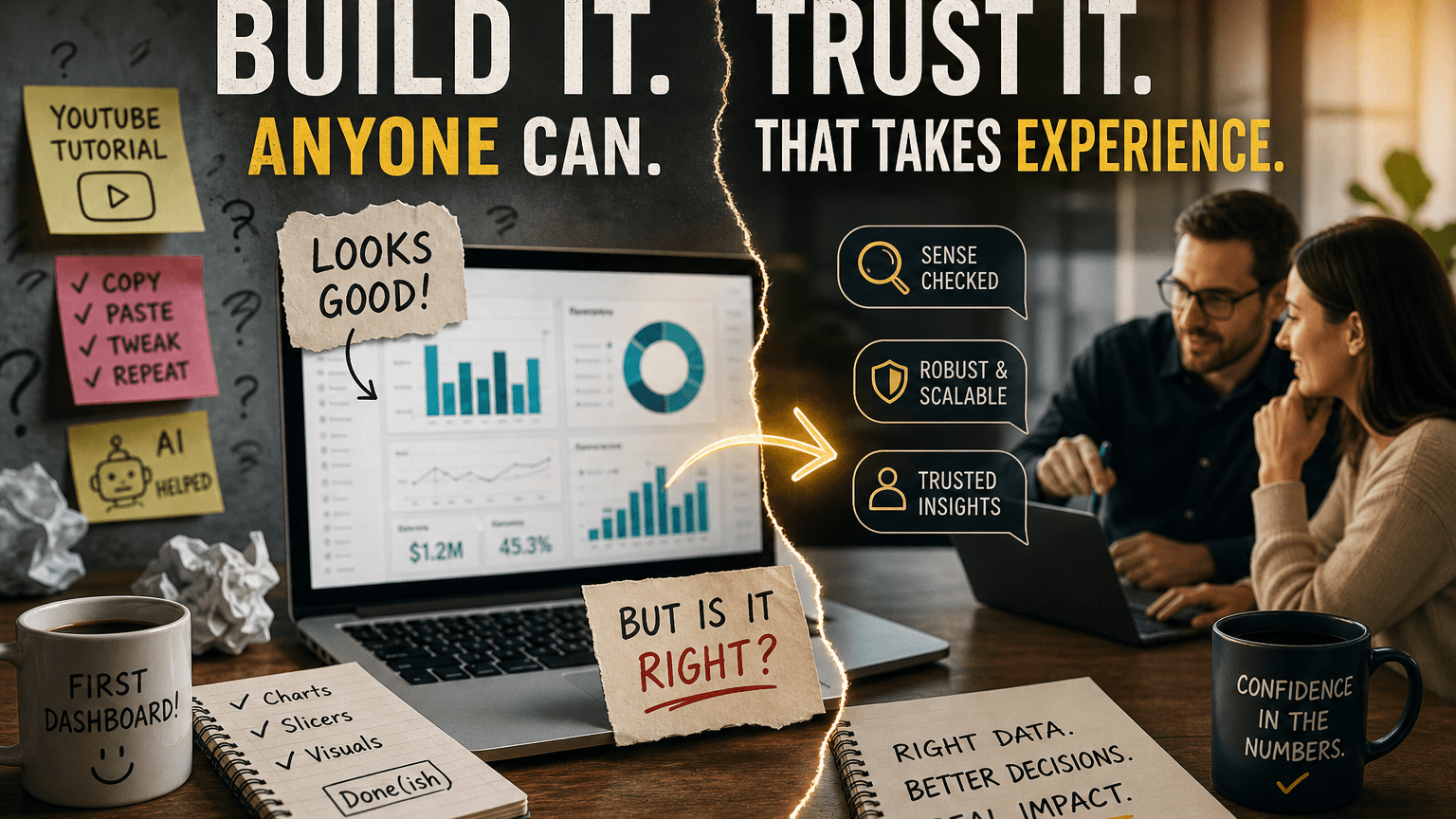
When “It Looks Right” Isn’t Quite the Same as “It Is Right”
I don’t come from a technical background. I was just an end user who got curious about Power BI and made the classic mistake of thinking ‘I’ll just have a quick go’… which, as it turns out, is how it all starts.
Like many people, I did what we all do when faced with something new and slightly intimidating… I went straight to YouTube. A few tutorials later, a couple of “copy exactly what they do” moments, and a generous amount of trial and error, I had something that I thought looked pretty cool. Nice visuals, interactive elements, slicers doing their thing… it was, in my opinion at the time, really good. I was soon put back in my box by a friend and told that I was barely scratching the surface.
On the surface, it worked. It looked good… and I was pretty impressed with myself.
But looking back, there was a gap between what I had built… and what I actually understood.
The Confidence Trap (We’ve All Been There)
If you had asked me how the data model was structured, you would have been met with a blank expression… followed by some confident sounding waffle.
I’d never even heard of Power Query or DAX… they sounded more like characters from a superhero film, let alone something I could explain or understand how they fit together. And if something broke? My “fix” strategy was essentially to retrace my steps, reopen the tutorial, and hope the answer revealed itself somewhere along the way.
In short, I could build something that looked cool. What I couldn’t do was confidently validate whether it was right.
And that’s a pretty important distinction.
Because in Business Intelligence, a report can look spot on… while quietly telling you the wrong story.
Two Years On… and Still Learning (Happily)
Fast forward two years into my role as Business Development Manager at PTR Associates, and I’ll be honest… I still don’t claim to fully understand the technical depth behind everything our consultants do.
And that’s probably a good thing.
The difference now is that I’ve seen what “good” really looks like, and more importantly, what sits behind it.
I see the types of questions our consultants ask as standard:
- Does this logic hold up across all scenarios?
- What happens when the data scales?
- Are we actually answering the right business question here?
These aren’t things you pick up from a quick tutorial or a late-night YouTube session.
They come from experience. From working on real projects, with real data, and real consequences… where “close enough” isn’t good enough.
What We’re Seeing with Clients
A lot of the organisations we speak to are in a very similar position to where I was.
They’ve taken the initiative, invested time in learning Power BI, and built reports internally. Often with a bit of help from AI, YouTube, and a fair amount of persistence.
And that’s a good thing.
But at some point, the questions start to creep in:
- Are we doing this the right way?
- Will this stand up as we grow?
- Can we trust these numbers completely… or mostly trust them, which is slightly more worrying?
That’s usually the moment where self-teaching starts to hit its limits.
Where Experience Really Adds Value
This is where real-world experience makes the difference.
Not by taking over, but by supporting what’s already there.
Quite often, what’s needed isn’t a full project or a complete rebuild:
- A second pair of eyes
- A sense check on approach and design
- Guidance through more complex challenges
- Reassurance that everything is accurate, robust, and not about to unravel the moment someone adds a new data source
It’s about having someone in the background who’s seen these challenges before… and knows where things go wrong.
A Better Way Forward
The most effective approach we see is a collaborative one.
Internal teams continue building their skills, developing their reports, and making the most of the tools available to them. And to be clear, tools like AI and YouTube are incredibly powerful. They make learning faster and far less intimidating than it used to be. You can go from zero to something that looks genuinely impressive in a surprisingly short space of time.
But there’s a catch.
Those tools are great at showing you how to build something. What they don’t always give you is the confidence that what you’ve built is right, scalable, or robust. There’s no real sense check. No one asking, “Does this actually hold up?” or “What happens when this gets used in the real world?”
That’s where the human element still matters.
Having experienced consultants available when needed doesn’t replace internal capability, it strengthens it. It gives teams the ability to sense check their approach, validate their thinking, and understand not just what to do, but why it works that way.
It’s where real knowledge transfer happens. Not just following steps, but learning how to think about data, how to challenge assumptions, and how to build with confidence rather than hope.
The result is a much stronger outcome. Greater confidence, reduced risk, and solutions that stand up over time, not just in the moment.
Because in Business Intelligence, the goal isn’t just to create reports that look good in a meeting.
It’s to create trust in the data behind them… even when someone asks that slightly awkward, “Are we sure this is right?” question.
A Final Thought
The accessibility of tools like Power BI is a brilliant thing. More people than ever can build reports, explore data, and take ownership of their insights.
I’ve been there myself. Building something that looks right, feels right, and gives you that satisfying sense of progress.
But over time, you realise that in Business Intelligence, looking right and being right are two very different things.
And that’s not a criticism of self-learning. It’s just the reality of working with data that informs real decisions.
Sometimes, you just need someone to sense check, challenge your thinking, or step in when things get more complex.
That’s where having the right support in the background makes all the difference.
If you’re building your own Power BI capability but want a bit of reassurance that you’re on the right track, feel free to get in touch.
CH
Chris Hope
Business Development Manager
As Business Development Manager at PTR Associates Ltd, I bring over 20 years of management and customer service experience to drive growth, build client relationships, and deliver tailored data consultancy solutions.
Frequently Asked Questions
Couldn’t find the answer you were looking for? Feel free to reach out to us! Our team of experts is here to help.
Contact Us