
Operational Reporting Consultancy Services
See the detail, act in the moment
Seeing the detail is vital to support the day to day running of any business. Operational reporting puts current, trustworthy information in front of the people who make real-time decisions, so the right action is taken while it still makes a difference.


Operational reporting is a different level
Most reporting conversations are really about strategy. Strategic and analytical reporting looks backwards over months at aggregated trends, and it belongs in the boardroom where leaders decide where the business is heading. Operational reporting sits at the opposite end. It is detailed rather than aggregated, current to the hour or the second rather than the month, and its job is to drive an action taken today rather than a direction set for next year.
In our experience most businesses are reasonably well served at the strategic level and quietly starved at the operational one. The monthly board pack arrives on time, yet the supervisor on shift, the warehouse lead and the duty manager are still working from yesterday's spreadsheet or from gut feel. That gap is expensive, because the moment to prevent a stockout, recover a slipping delivery or rebalance a shift has usually passed by the time anyone sees it in a report.
What are your operational challenges?
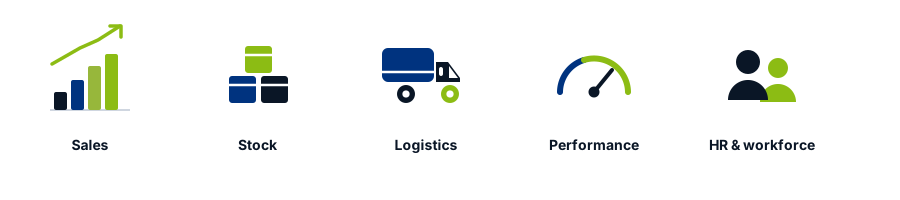
The symptoms differ by domain but the root cause is the same, information that arrives too late and too coarse to act on. In sales, the order book and the picture of the day against target are often hours out of date, so nobody knows where the day really stands until it is over. In stock management, reorder points are watched manually if at all, which is how stockouts and ageing inventory both happen, the first losing sales and the second tying up cash on the shelf.
In logistics, on-time-in-full and delivery exceptions tend to be visible only after the fact, once the customer has already been let down. Performance tracking suffers from having no single live view, with service levels and key measures scattered across systems and rebuilt by hand each week. Across HR and the wider workforce, absence, time and attendance and shift coverage are pieced together from several places, so a gap on tomorrow's rota is spotted far later than it needs to be.
"By the time the monthly report lands, the moment to act has already passed."
How can PTR help?
Good operational reporting is a design problem about freshness, detail and distribution, not simply another dashboard bolted on at the end. We start from the decisions your people actually make and how quickly they have to make them, then work backwards to the data. We connect to the source systems where the operation really happens, the order system, the warehouse management system, the telematics feed, the rota, using whichever tools fit your environment.
From there we choose the right freshness mechanism for each case rather than forcing everything to be live at great cost. Some figures are fine refreshed on a schedule, some need querying on demand, some justify the speed and currency of Direct Lake, and a few genuinely call for Real-Time Intelligence. Finally we deliver the result in the form the operation needs, whether that is a live dashboard, a pixel-perfect printable document or an automated alert that reaches the right person without anyone watching a screen.
Operational reporting in practice
Live operational dashboards
We build Power BI semantic models on Direct Lake or DirectQuery so the dashboard your team relies on stays current without slow refreshes. These are designed for the frontline rather than the boardroom, leading with the operational measures that matter, highlighting the exceptions that need attention and letting people drill straight to the underlying detail when they need to understand a number.
Seeing the detail with paginated reports
Some operational documents have to be exact and print-ready, and a dashboard is the wrong tool for them. Using Report Builder we produce paginated reports for the pixel-perfect documents the operation runs on, pick lists, despatch notes, invoices, shift rosters and detailed stock reports. Data-driven subscriptions then burst the right report to the right person automatically, so every depot, region or manager receives exactly their slice without anyone assembling it by hand.
Real-time intelligence and alerting
When data arrives constantly and decisions cannot wait, we use Fabric Real-Time Intelligence, ingesting high-frequency events through an Eventstream into an Eventhouse and surfacing them on real-time dashboards. Fabric Activator then watches for the conditions that matter, such as stock dropping below its reorder point or a delivery beginning to slip its service level, and the moment a condition is met it fires, triggering an alert or an action so the response happens automatically rather than waiting for someone to notice.
What you get
The outcome is a set of current numbers that everyone trusts, the same picture whether you are on the floor or in the office. Exceptions are caught and acted on in the moment rather than explained away afterwards, and your frontline staff stop rebuilding the same spreadsheets every morning because the live view is already there and already right. Decisions move from looking back at what happened to acting on what is happening now.
"Current numbers everyone trusts, acted on while they still matter."
Where do you start?
Our typical engagement works from the decision back to the data, so the solution stays grounded in what your people actually need to do.
Frequently Asked Questions
Couldn’t find the answer you were looking for? Feel free to reach out to us! Our team of experts is here to help.
Contact Us