
Realtime Data Consultancy Services
See what is happening as it happens
Streaming data from your sensors, vehicles and apps flows onto a live view, built on Azure and Microsoft Fabric Real-Time Intelligence, so you see and act the moment something happens rather than from a report the next morning.
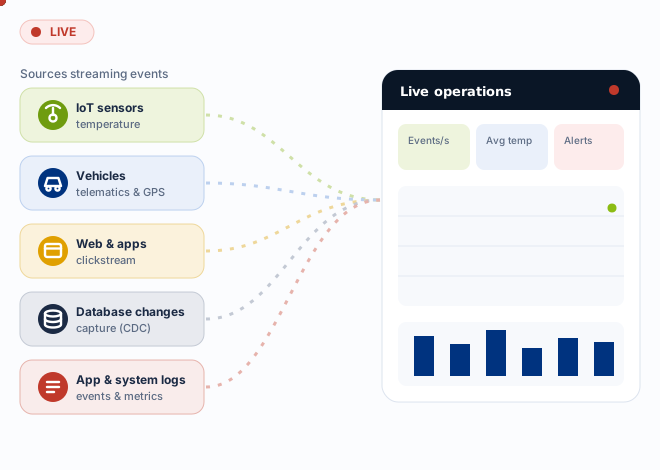
Data at rest tells you what happened. Data in motion tells you what is happening.
Most reporting works on data at rest. Something happens out in the business, a sale goes through, a sensor reading spikes, a van leaves the depot, and a copy of it is collected up later, loaded overnight, and presented the next morning. That is fine for understanding trends and looking back, but by the time you read it the moment has passed. The reading that mattered, the van that was idling, the queue that was building, all of it is now history.
Realtime data is the opposite idea. Instead of waiting for the next batch, each event is sent on the instant it occurs and carried straight through to where it can be seen and acted on. The data is treated as a continuous live feed rather than a snapshot taken hours ago. You stop asking what happened yesterday and start seeing what is happening right now, while you can still do something about it.
That shift is what makes a difference operationally. When a temperature drifts out of range, a delivery starts slipping, or traffic on a service suddenly surges, the value is in knowing immediately, not in a report that confirms it after the cost has been paid. This page is about getting that live feed in place reliably and affordably. For the reporting and decision-making that sits on top of it, see our operational reporting page.
What are your challenges?
The first is simply timing. The information exists somewhere, but it reaches the people who need it too late to be useful, so decisions are always made a step behind reality. The second is volume and speed. High-frequency events from devices, vehicles and applications arrive far faster and in far greater number than tools built for nightly batches were ever meant to handle, and they buckle under the load.
Streams are also messy in their own way. Events arrive out of order, get duplicated when a device reconnects, or turn up late after a patchy connection, and naive handling quietly double-counts or drops them. Even when the data is flowing, often no one is actually watching for the one moment that matters, so the alert that should have fired never does. And underneath it all sits cost, because making everything live, all the time, is expensive and rarely necessary.

"By the time it reached a report, the moment you could have acted on it had already gone."
How can PTR help?
We start from a simple question: which moments are actually worth knowing about the instant they happen? Going live everywhere is costly and usually unnecessary, so we pick the feeds where speed genuinely changes the decision and design those properly, leaving the rest on a sensible scheduled refresh. That keeps the result fast where it matters and affordable everywhere else.
A pipeline built for events, not batches
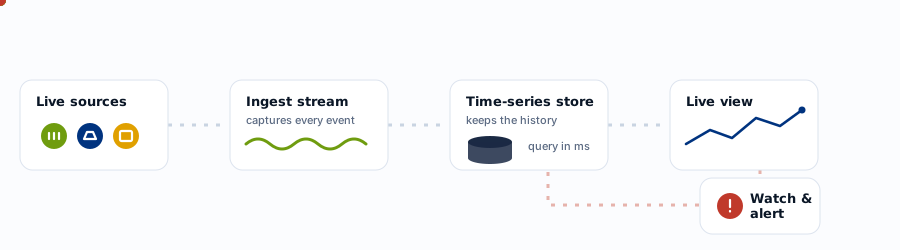
For the feeds that need it, we put in a streaming pipeline designed for events in motion. Each source sends its events as they happen into a Microsoft Fabric eventstream, or into Azure Event Hubs, Azure IoT Hub or Azure Stream Analytics, which can absorb high volumes without falling over. Those events land in a Fabric eventhouse, the KQL database built on Azure Data Explorer, where time-series data can be queried in milliseconds with Kusto Query Language. From there the same store drives both a live view and the logic that watches for conditions. Late, duplicated and out-of-order events are handled deliberately, so what you see is accurate and not double-counted. We build on the Microsoft tooling you already run rather than bolting on something new to maintain.
A live view people can trust at a glance
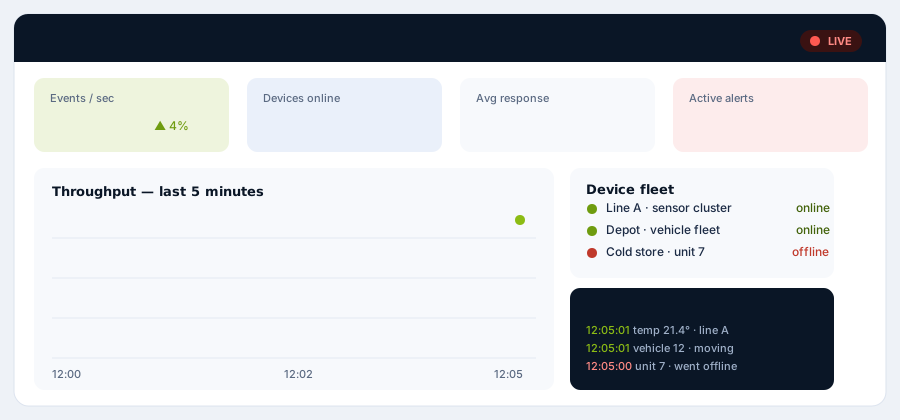
The point of all this is a screen that tells the truth about right now. We build Fabric Real-Time Dashboards and Power BI reports that update continuously as events arrive, with the few numbers that matter, throughput, devices online, response times and any active alerts, shown large and current, alongside a live chart of how things are trending over the last minutes rather than the last month. A device fleet panel makes it obvious the moment a unit drops offline, and a running feed of the latest events lets an operator see the detail behind the headline. It is designed to be glanced at and understood, not studied.
Acting automatically, not just watching
A live screen still relies on someone looking at it. So for the conditions that genuinely matter, we use Fabric Activator, the Data Activator capability, to set the stream to watch itself and act, raising an alert to the right person through Teams or email, or triggering a downstream action, the instant a threshold is crossed rather than waiting for someone to notice. This is the same real-time alerting approach we cover in depth on the operational reporting page, applied here directly to the live feed.
Throughout, we either run the live feed for you as a managed capability or build it alongside your team and mentor them to own it, whichever fits how you want to work.
Built on Azure and Microsoft Fabric
As a Microsoft Solutions Partner for Azure and Data & AI, we deliver realtime data on the services you are most likely already licensed for, rather than introducing a separate stack to learn and maintain. At the centre is Microsoft Fabric Real-Time Intelligence, the end-to-end capability that ingests, stores, analyses and acts on streaming data inside Fabric. Its eventstream captures events from across the business, the eventhouse and its KQL databases hold high-volume time-series data for sub-second queries, Real-Time Dashboards and Power BI surface it live, and Fabric Activator triggers alerts and actions automatically.
Where data originates in Azure, or needs more control before it reaches Fabric, we use the wider real-time platform alongside it: Azure Event Hubs and Azure IoT Hub for high-throughput ingestion, Apache Kafka and MQTT endpoints for device and partner feeds, Azure Stream Analytics for in-flight processing, Change Data Capture for picking up database changes as they happen, and Azure Data Explorer with Kusto Query Language for interactive analytics at scale. The result is one coherent real-time architecture across Azure and Fabric, not a collection of disconnected tools.
Where do you start?
We usually begin by separating the genuinely time-critical feeds from everything else, so effort and cost go where speed actually changes a decision, and the rest stays on a simple schedule.
Frequently Asked Questions
Couldn’t find the answer you were looking for? Feel free to reach out to us! Our team of experts is here to help.
Contact Us