
Technology
Data priorities for 2027
Gartner, BARC and Info-Tech agree that AI is driving the data agenda, but the work being prioritised is foundational. Four data priorities for 2027, a question to ask your team for each, and where Microsoft Fabric fits.

Published
Your 2027 AI plan depends on data you may not trust yet
Picture a satnav that has not had a map update for years. It still speaks with the same calm confidence, and it will still send you down a road that closed last spring.
AI tools behave in much the same way when they work from data nobody has checked. They answer fluently, and the answer is only as good as the map underneath. That map is your data.
Many organisations are now asking what their AI plan for 2027 should be. The independent research suggests a different first question: is our data ready? Gartner, BARC and Info-Tech all point the same way. AI is driving the data agenda, yet the work being prioritised is foundational.
What the research says about AI and data readiness
Info-Tech’s Data Priorities 2027 finds that AI adoption is outpacing the readiness of the data and controls it depends on. Gartner reports that lack of data readiness is a top barrier to AI, and that over 75% of organisations are prioritising investment in AI-ready data. BARC surveyed 1,579 users, consultants and software vendors, and its top five trends were all foundational topics, with data quality first.
BARC’s top 10 and what each could mean for 2027
BARC’s Data, BI and Analytics Trend Monitor 2026 asked 1,579 users, consultants and software vendors to rate 20 trends out of 10. Here are the top ten, with our view of what each could do for a business in 2027. BARC ran its survey for 2026, so the 2027 comments are our own reading.
# | BARC trend | Score | What it could do in 2027 (PTR view) |
1 | Data quality management | 7.9 | Ends arguments over whose numbers are right, and gives AI data you have already checked. |
2 | Data security & privacy | 7.9 | Lets you open data to more people and AI tools without opening it to the wrong ones. |
3 | Data-driven culture | 7.3 | Meetings start from the same figures, so less time goes on debating the spreadsheet. |
4 | Data & AI governance | 6.9 | Clear ownership of the rules, so AI tools and agents can be given work within set limits. |
5 | Data & AI literacy | 6.5 | Staff who can question an AI answer before it reaches a customer or a board paper. |
6 | Self-service analytics & data discovery | 6.5 | Business teams answer their own questions, and the BI team gets fewer report requests. |
7 | AI/ML/advanced analytics | 6.4 | Forecasting and pattern-finding that is only as dependable as the data behind it. |
8 | Data warehouse modernisation | 6.1 | One governed platform in place of ageing systems, which is where Microsoft Fabric fits. |
9 | Data preparation by business users | 5.9 | Faster cleaning without waiting on IT, with guardrails against creating more versions of the truth. |
10 | Data catalogues & data intelligence platforms | 5.7 | A searchable record of what data exists, who owns it and whether it can be trusted, which is where Microsoft Purview fits. |
The top five are all about trust, people and rules. AI and machine learning comes seventh, generative AI thirteenth and agentic AI nineteenth of 20, which BARC reads as organisations building strong foundations before scaling advanced use cases.
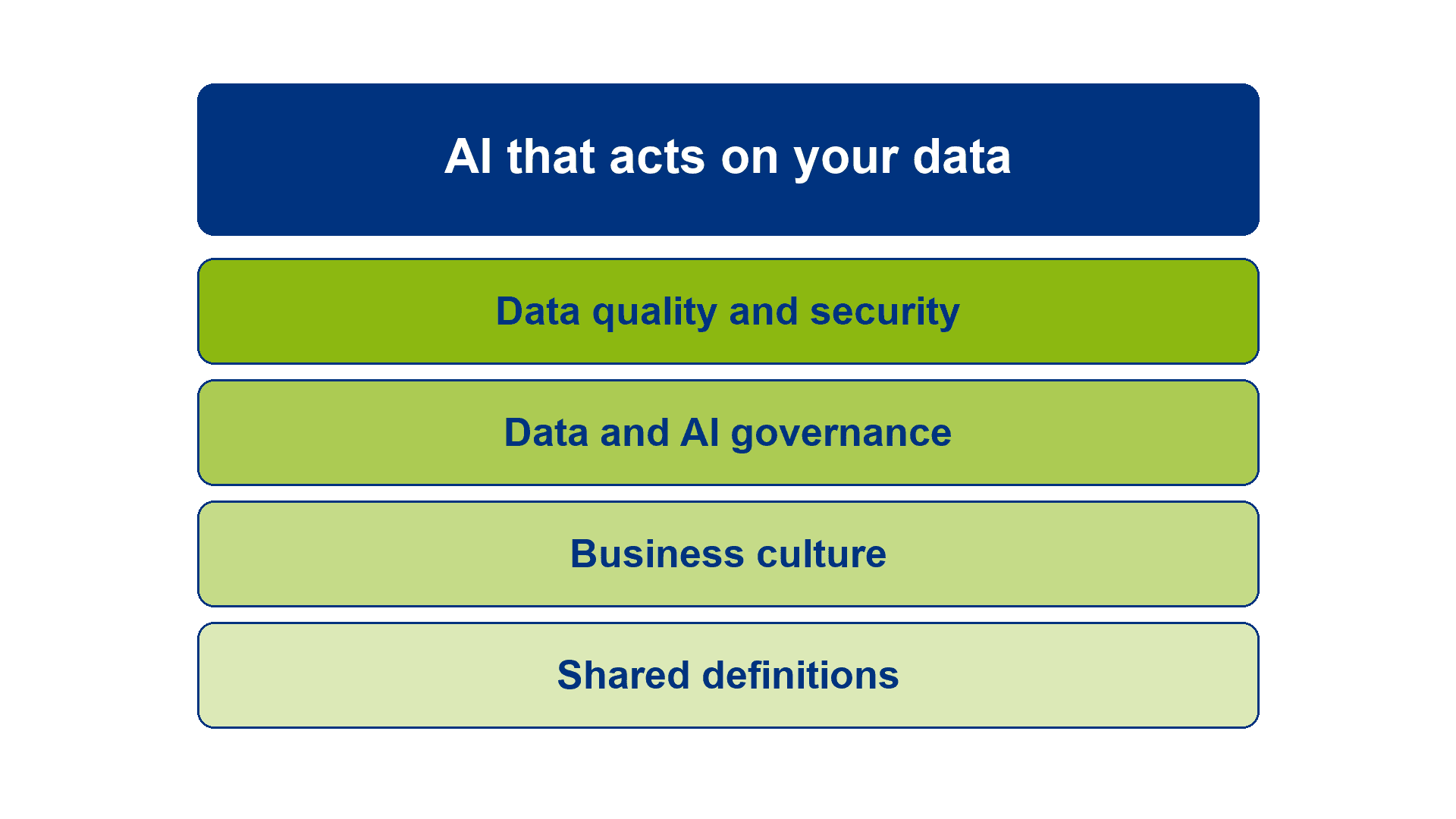
Four priorities come out of that research, together with Info-Tech’s call for shared definitions. Each has a question you can put to your own team this week.
Four data priorities for 2027
Data quality and security come first
BARC’s 2026 Trend Monitor puts data quality management at number one. Data security and privacy follow closely, and both score 7.9 out of 10. They belong together because an AI tool that can reach poor data, or sensitive data, will act on whatever it finds.
Ask your team: would you trust your data enough to let AI act on it?
Microsoft Fabric can help with both sides. AI can assist with the cleaning itself, which we cover in AI-assisted data cleansing in Microsoft Fabric. On the security side, OneLake security lets you set the access rules once and apply them across every report. If you want the wider view, we have also written about checking what AI is building on.
Govern data and AI together
“Strengthen data and AI governance” is the number one priority for chief data and analytics officers in Gartner’s survey of 350 CDAOs, and it is the first year AI governance has been named explicitly. Info-Tech’s 2027 priorities go a step further and include governing AI agents as they operate.
Ask your team: who owns the rules for how AI uses your data?
Our data strategy and data governance work sets out those rules and the controls behind them. Microsoft Purview then helps you understand, protect and manage data across its locations. If agents are already in play, working with AI agents securely in your own Azure tenancy is a good next read.
Fix the culture as well as the tools
Gartner found that cultural resistance (60%) outweighs funding (40%) as the reason governance initiatives fail. It also predicts that 60% of organisations that ignore this will fail to govern AI successfully by 2027.
Gartner’s priority rankings show the same pattern building over time. In its Leadership Perspective Survey, data-driven culture ranked fifth in 2024, fourth in 2025 and second in March 2026, when 350 CDAOs responded. A larger May 2026 cut of the same survey puts it third. CDAOs are further along than many of BARC’s respondents, in our view, so the climb suggests culture becomes the sticking point once the first tools are in place. Gartner also reports that 83% of CDAOs are running or planning data literacy programmes within the next year.
Governance tends to stall when the business sees it as an IT job. Finance, operations and sales teams need to see the rules as theirs, and in our experience that takes some hands-on training and a few early, visible wins more than another policy document.
Ask your team: do your business teams see governance as theirs, or as IT’s job?
We run tailored training for teams, either onsite or virtually, built around the data your people actually use.
Shared definitions that work for people and AI
Info-Tech’s 2027 priorities include shared business definitions that work for people and AI, and unifying operational, analytical and unstructured data. Ask Finance what a customer is, then ask the AI tool. If the two answers differ, someone will spend a meeting deciding which is right.
Ask your team: if Finance and an AI tool both answer “what is a customer?”, do they agree?
We have written up an example of using unified reporting to align Finance and Project Management on clearer profit numbers.
Where Microsoft Fabric fits
Microsoft Fabric brings data engineering, data warehousing and Power BI reporting onto one platform, so quality, security and definition rules can be applied in one place instead of in each tool. Fabric is the core of how we deliver this work, and PTR is a Microsoft Solutions Partner for Azure and Data & AI.
If you are planning a move from Synapse, SQL or Power BI Premium, or a new set-up, the four priorities above make a useful checklist to work through before you build. Our Microsoft Fabric consultancy team can help you do that.
How PTR can help
For over 35 years we have helped organisations trust their data, then built the reporting, AI and automation on top of it, leaving their teams confident to run it themselves. Our AI readiness and data foundations service is the usual starting point.
Start with whichever of the four questions made your team pause. If you would like a second opinion on the answer, talk to PTR about getting your data AI-ready, or tell us which priority is most on your mind and we will suggest where to begin.
MD
Mandy Doward
Managing Director
PTR’s owner and Managing Director is a Microsoft certified Business Intelligence (BI) Consultant, with over 35 years of experience working with data analytics and BI.

Frequently Asked Questions
Couldn’t find the answer you were looking for? Feel free to reach out to us! Our team of experts is here to help.
Contact Us