
Tech Tips
SQL Server 2025 and AI: Getting Your Existing Business Data Ready
SQL Server 2025 adds two new functions that turn documents and customer feedback into AI-ready data. Find out how chunking and embeddings work in plain English, where Microsoft Fabric fits in, and why you can make a start without a big migration.

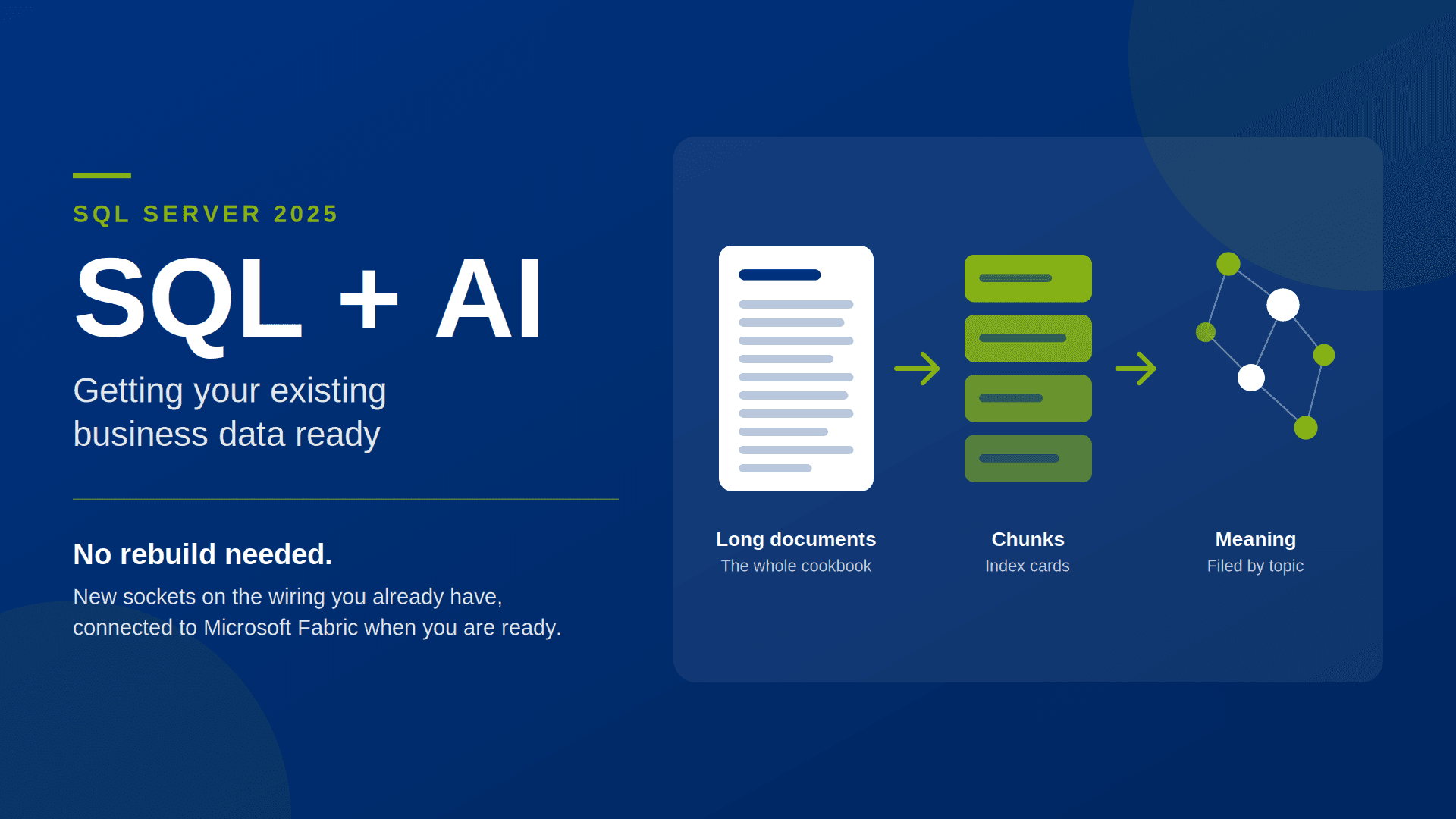
Most businesses already have the information their AI tools need. The problem is that it sits in documents, manuals and customer comments that AI can't easily use. SQL Server 2025 adds two new functions that help close that gap: AI_GENERATE_CHUNKS and AI_GENERATE_EMBEDDINGS. You don't need to rebuild anything to use them. Think of it as fitting new sockets to the wiring you already have, rather than rewiring the whole house.
AI_GENERATE_CHUNKS: cutting the recipe book into index cards
Imagine asking a chef for one recipe and being handed the entire cookbook. AI has the same problem with long documents. This function cuts text into smaller, manageable pieces, like index cards, so the right piece can be found quickly. Your product guides, support manuals and customer feedback can all be prepared this way.
It's a mechanical process. The function splits text by size, with an option to overlap pieces so nothing is lost at the edges. It doesn't use AI to do the cutting, and it needs your database set to compatibility level 170 or higher.
AI_GENERATE_EMBEDDINGS: filing by meaning, not by title
A traditional search is like a library catalogue that only matches titles. If you search for "send an item back" but the document is called "Returns policy", you find nothing. Embeddings work more like a librarian who shelves books by topic. A customer asking "How do I send an item back?" lands on your returns policy, even though the words don't match.
The function converts text into a numerical fingerprint of its meaning. To do this it needs an AI model, which you register in the database and which runs at a separate endpoint. That means your text is sent to that model for processing, so it's worth agreeing your data governance position first.
Why this matters: the open-book exam
Together, these functions prepare your data for what's known as retrieval-augmented generation (RAG). It works like an open-book exam: before the AI answers a question, it looks up the relevant pages from your own documents. The answers are then based on your information, not on guesswork.
Where does Microsoft Fabric fit?
These functions aren't limited to SQL Server. They're also available in Azure SQL and in SQL database in Microsoft Fabric. Fabric adds further AI functions for summarising, classifying, translating and analysing sentiment in text, so it gives you a clear route from preparing data to putting it to work across the wider Microsoft data platform.
Do you need to move to Fabric first?
Not necessarily. Many businesses worry that using Fabric means a big move out of their current SQL Server or Azure SQL setup. It doesn't have to. Fabric can mirror your existing databases, keeping a live copy that updates automatically, so you can report on and prepare your data for AI without touching the systems your business relies on every day. It's like watching a live scoreboard from the stands rather than walking onto the pitch.
If a fuller move to Fabric makes sense later, you can do it in stages, at your own pace, on the back of early wins. See how this works in practice in our article on Fabric database mirroring for manufacturers.
Where PTR can help
Technology alone won't deliver value. You also need a sensible plan and a team confident enough to run it. PTR blends expert consultancy with practical training and mentoring. We help you decide which data is worth preparing first, connect it safely to what you already have, and upskill your people so they can carry on without us. When you're ready, we can also plan a staged move to Fabric.
Book a free assessment and we'll identify your top three quick-win opportunities for getting your existing data AI-ready.
DB
David Birch
Business Intelligence Consultant
Dave works with a variety of clients, from start-ups that require advice on setting up their first BI resources, to large and mature businesses, who require collaboration on long-term projects.
Frequently Asked Questions
Couldn’t find the answer you were looking for? Feel free to reach out to us! Our team of experts is here to help.
Contact Us