Tech Tips
What is Decision Intelligence?
Taking the leap to Decision Intelligence (DI) ensure that actions always drive outcomes

Have you heard of the term Decision Intelligence (DI) as opposed to Business Intelligence (BI)?
This term which many may deem as a new term in the data world entered the mainstream in around 2021/2022. Gartner published an article in May 2022 “Is Decision Intelligence The New AI?”. This may seem a bit odd given that most of the world only seems to have woken up to AI over the last 12 to 24 months, and the question over it being superseded was already out there in 2022!
In this article the author asks why decision intelligence is important and leads the answer with:
“Companies’ successes depend on decisions.”
So, if we can improve the quality and speed of decisions, we should be able to drive the success of our business. This is where Decision Intelligence fits – it uses a combination of methods and technologies to improve decision making decision mapping and decision theories.
The three layers to a Decision Intelligence system are:
Decision Support – human decisions prompted by alerts, data analytics and exploration
Decision Augmentation – analyse data and generate AI driven predictions for humans to review and act upon
Decision Automation – reduce the human involvement and automate the decisions
In a nutshell Decision Intelligence automates the analysis, exploration, identification of potential decisions, and automates the actions for the decision it deems the best fit and optimum outcome.
Decision Intelligence (DI) v Business Intelligence (BI)
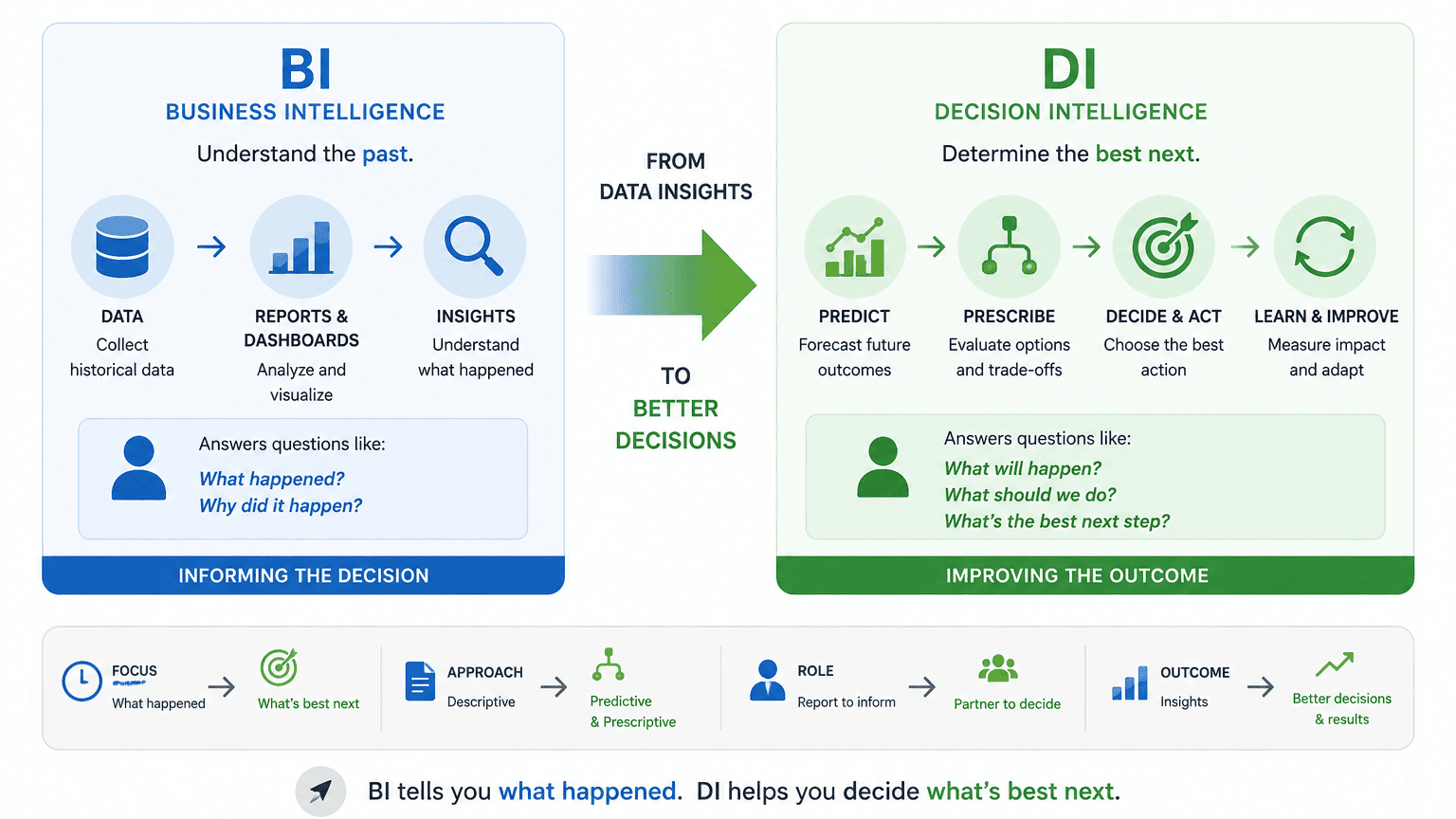
For years we have understood the importance of Business Intelligence (BI) and how it empowers us with critical business information that can inform quality data driven decisions.
This still holds true, but in many cases delivering the insights does not always result in successful or consistent data driven decisions.
The human element kicks in and we find that there may be a nervousness in believing the data and acting on what we see, or different people may read the insights differently and come up with varying sets of decisions and actions. The result being NO ACTION TAKEN.
Taking the leap to Decision Intelligence (DI) ensure actions always ensue based on carefully defined business rules.
Business Intelligence (BI) is descriptive and diagnostic, outputting visualisations that are interpreted by humans. BI utilises data pipelines and dashboard software.
Decision Intelligence (DI) is prescriptive and proactive, outputting operational choices and actions implemented by a hybrid automation framework - less reliance on humans. DI utilises an integrated orchestration framework which sits on top of BI data and uses machine learning, business rules, optimisation algorithms and digital feedback loops to track decision accuracy.
How do we measure success with BI and DI? DI success is more quantifiable than BI success with clear financial KPIs to determine success.
BI success is measured through user adoption and data accessibility.
DI success is measured through business outcomes.
Capability / Feature | Business Intelligence (BI) | Decision Intelligence (DI) |
Primary Focus | Data visualization & reporting | Decision modelling & execution |
Temporal View | Past and present | Future outcomes and consequences |
System Goal | Informed humans | Optimized actions |
Core Input | Structured historical data | Live data, ML predictions, & policy rules |
Action Link | Disconnected (requires human effort) | Connected (direct execution layer) |
A Retail Decision Intelligence Scenario – High Value Inventory Markdown
In this scenario we see how Decision Intelligence system could drive the best decision for a retail business when confronted with seasonal inventory that is at risk of not selling.
Decision Support Step
A high value winter coat is still in store stock as we approach Spring.
Decision Augmentation Step
An inventory forecasting model predicts that the winter coat has an 80% chance of remaining unsold by the time the Spring season starts, moving into the “dead stock” category.
Decision Automation
The Decision Intelligence algorithm has been configured with a number of key influencers/rules:
- Warehouse space is restricted
- Minimum gross margin has been set at 35%
- Compare competitor pricing
- Brand integrity important
The Decision Intelligence Engine identifies three potential outcomes:
- Bulk clearance at 50% discount
- Do nothing
- Trigger a 25% targeted discount via a mobile app to high loyalty customers who live close to stores holding stock
Outcome 1 violates the minimum margin rule so is ruled out.
Outcome 2 potentially results in a loss if unsold coats have to be shipped to an outlet store, and the warehouse does not have adequate space so is ruled out.
Outcome 3 results in protecting margin, protecting the brand integrity by retaining a higher margin and avoids warehouse storage of unsold goods.
Selected Outcome: Outcome 3 is selected and triggers a targeted discount app campaign and triggers an automated stock transfer from stores to app store hub.
If you are wondering how you can make the move from Business Intelligence to Decision Intelligence, get in touch with us today and arrange a call with one of our DI experts to get you started.
MD
Mandy Doward
Managing Director
PTR’s owner and Managing Director is a Microsoft certified Business Intelligence (BI) Consultant, with over 35 years of experience working with data analytics and BI.
Frequently Asked Questions
Couldn’t find the answer you were looking for? Feel free to reach out to us! Our team of experts is here to help.
Contact Us