
Predictive Analytics and Forecasting Consultancy Services
Turn your history into a forecast you can act on
Predictive analytics uses machine learning and statistical modelling to find the patterns in your history and estimate what happens next, so the numbers you plan around rest on evidence rather than a spreadsheet guess.
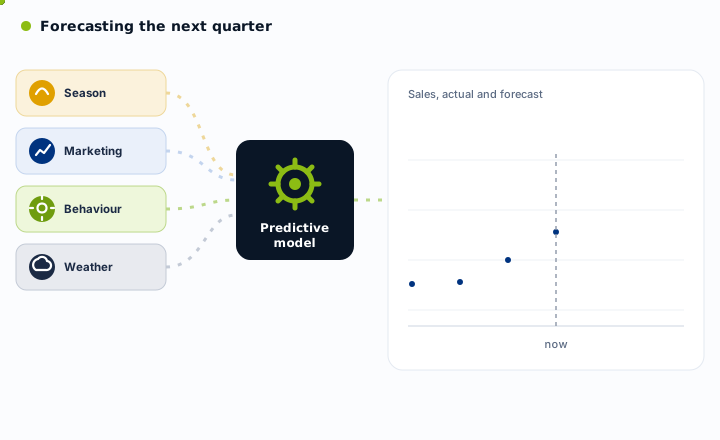

Look forward using the patterns you already have
Every business already carries a record of what has happened: sales made, stock moved, invoices paid late, customers who came back and customers who did not. Predictive analytics uses machine learning and statistical modelling to identify the patterns in that history and estimate what will happen next, turning a record of the past into a usable view of the likely future.
It is the natural next step once your data has been shown to hold a genuine signal. How the underlying patterns are found and how the right model is chosen is covered on our machine learning model development page; predictive pforecasting is about putting those techniques to work to generate the numbers a business actually plans around.
From question to decision
Teams rarely come to forecasting for a number on its own. They arrive with a decision to make, and each of the questions we hear most often maps directly to an action the forecast informs:
What will sales be next month? | → plan budgets and set realistic targets |
How much stock should we order? | → hold the right inventory, avoiding stockouts and waste |
How much demand should we expect? | → line up capacity, staffing and supply in advance |
Which customers are likely to buy again? | → focus retention and marketing where it pays off |
Which customers are likely to pay late, or leave? | → step in early with credit control or a retention offer |
Which projects are likely to overrun? | → intervene on delivery before a deadline slips |
Each is a question about the future that your own history can help answer, provided the data behind it holds up. Whether it does, meaning enough historical depth and a genuine pattern to learn from, is exactly what our ideation and experimentation stage establishes before any forecast is built.
It is cheaper to forecast with evidence than to plan on a guess.
When is forecasting useful?
Forecasting is not always the right tool. It earns its keep when four things line up:
An actionable outcome
A real decision is waiting on the result, not just curiosity.
Patterns in the data
The past holds repeatable structure a model can learn from.
Enough history
There is sufficient data, across enough time, to train on.
Estimated today
Decisions currently lean on manual judgement or a gut feel.
Where those line up, a model can replace gut feel with something measurable and repeatable that improves as more data arrives. Where they do not, we will say so plainly rather than build a forecast that only looks convincing, because a number nobody can act on, or one drawn from too little history, helps no one.
More than a trend line
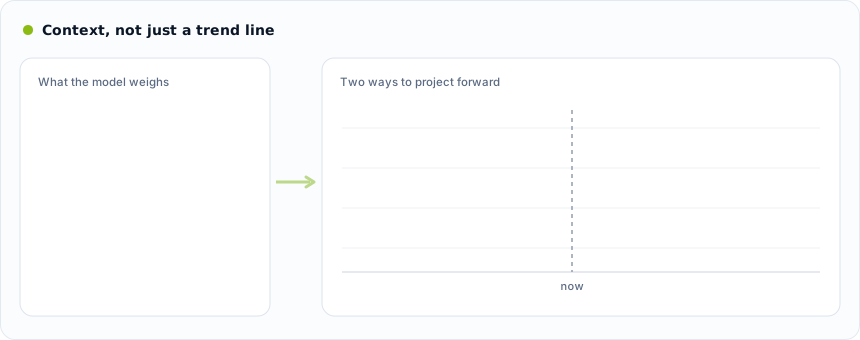
Predictive forecasting starts from historic trends, but it does not stop there. A spreadsheet extrapolation assumes the future is a straight continuation of the past; a good model instead weighs the factors that genuinely push a number up or down:
- Seasonal trends and the time of year
- Customer behaviour
- Marketing activity
- Product changes
- External events, such as weather
Combining these gives a model the context that a simple trend line lacks. It is why a well-built predictive model typically forecasts more accurately than traditional spreadsheet-based methods, and why it can hold up when conditions shift rather than quietly drifting away from reality.
Validating the forecast's performance
A forecast is only useful once you know how accurate it actually is, so before one informs a decision we validate its performance against data the model was never trained on. Three checks do most of the work:
- Split the historical data into training and testing sets, then measure accuracy on the portion held back to see how it does on unseen cases
- Repeat that measurement across several different splits, known as cross validation, to confirm the model is consistently accurate rather than lucky on one
- Track the forecasts against actual outcomes as they arrive, so performance is proven in the real world and not just in testing
Validating this way measures not only how accurate a model is on average but how steady that accuracy stays, which is what tells you whether a forecast can be planned around. The same analysis surfaces a further benefit: the key drivers behind a prediction. Knowing which factors most influence the outcome tells you what actually moves the number, not just what the number is likely to be.
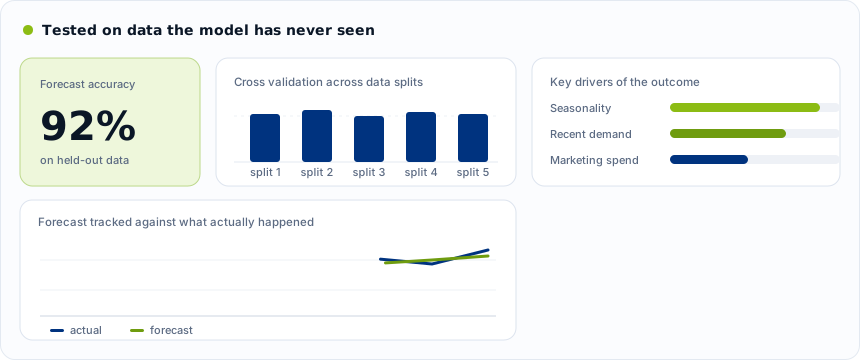
A forecast is only worth acting on once its accuracy has been measured, not assumed.
What techniques may be used
Data science is not one-size-fits-all. Which approach fits depends on the problem, the data and the horizon you need to plan over, and the right answer often combines several:
- Time series forecasting for data that moves with time
- Regression models for predicting a number from its drivers
- Machine learning algorithms for complex, non-linear patterns
- Feature engineering to build more useful inputs from the raw data
- Trend decomposition to separate the underlying direction from the noise
- Seasonal analysis to capture recurring cycles
Part of the work is knowing which of these to reach for, and when to combine them, rather than forcing every problem through the same technique.
How can PTR help?
We act as the bridge between the business question and the forecast that answers it, and we stay accountable for accuracy the whole way through. In practice we:
- Understand the business problem and define a clear objective
- Identify the specific outcome to predict
- Determine the forecasting horizon you need to plan over
- Define how accuracy will be measured
- Review the data to assess whether it can support the forecast, covered in more depth on ourAI Readinesspage
- Ensure consistency and enough historical depth, and fill gaps where information is missing
- Evaluate and select the predictive model best suited to the problem
- Train the model and optimise how it performs
The aim throughout is a forecast the business can understand and act on, with its accuracy stated honestly and its limitations made clear, never a black box you are asked to trust on faith.
Where do you start?
We frame the work as a clear sequence, from the decision you need to make through to a tested forecast you can plan around and keep checking against reality.
Frequently Asked Questions
Couldn’t find the answer you were looking for? Feel free to reach out to us! Our team of experts is here to help.
Contact Us