As a certified
Microsoft Solutions Partner, PTR delivers tailored
Microsoft Fabric consultancy and training to help UK businesses seamlessly migrate from legacy Azure or on-premise systems into a single, high-performance analytics platform. Whether you need to build a modern
Medallion architecture or optimise your Power BI workflows, our UK-based consultants provide the
collaborative mentoring and technical strategy required to accelerate your data journey.
You can learn more about our migration frameworks, register your interest for a free one hour Microsoft Fabric Migration consultation or find out more about our Microsoft Fabric consultation services by
contacting us.
Microsoft Fabric is a unified data platform that brings together essential components of analytics into one environment. It includes tools for data integration, data engineering, data science, real-time analytics, and business intelligence. With features like OneLake - a unified data lake for the entire organisation - and browser-based development capabilities, Fabric simplifies workflows and reduces the need for multiple tools. This makes it a strong option for organisations aiming to streamline their data operations and improve insights.
Microsoft Fabric is an evolution of several existing Microsoft analytics products, consolidated into a single administrative environment and licensing model which makes licensing, development, and administration much simpler.
Microsoft Fabric offers the perfect
Decision Intelligence (DI) Platform and Infrastructure, offering all the services and tools to help you deliver improved decision making across your organisation.
Getting started with Microsoft Fabric might seem a little daunting but with some hand holding and support you can be up and running in Fabric fairly quickly.
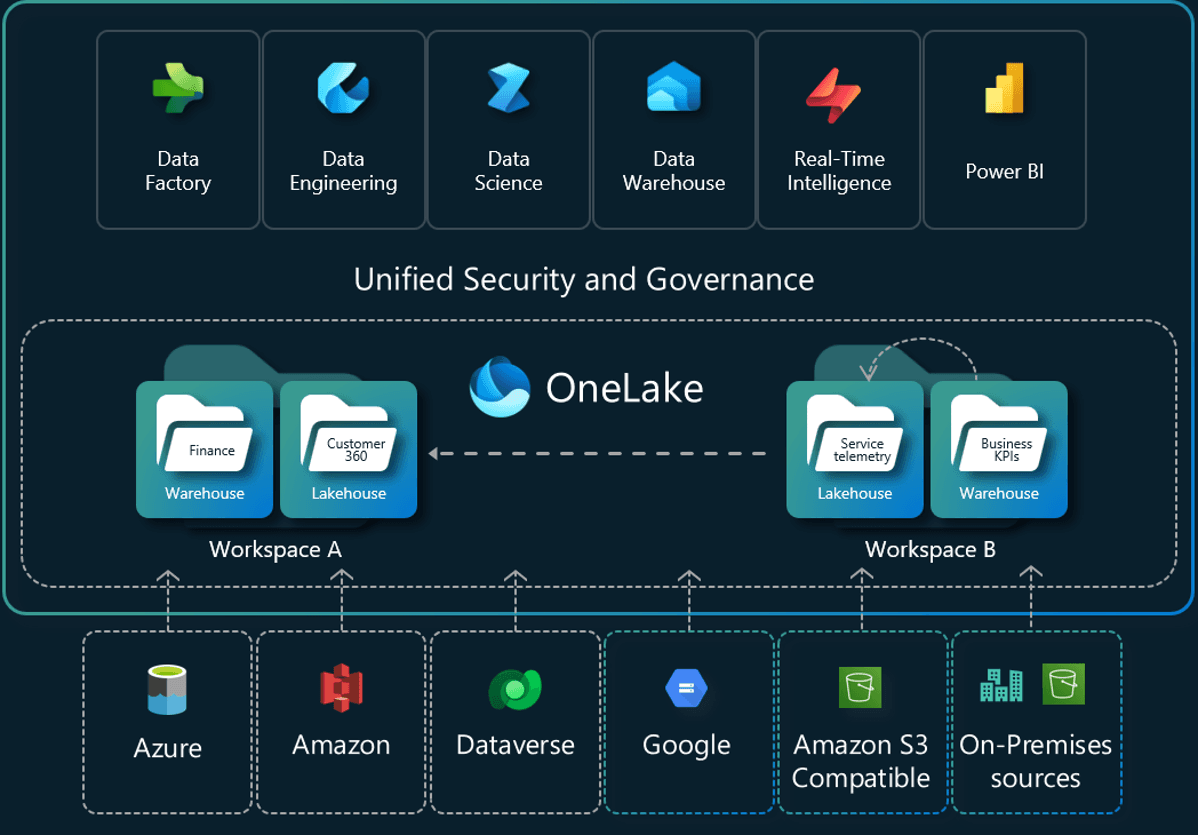
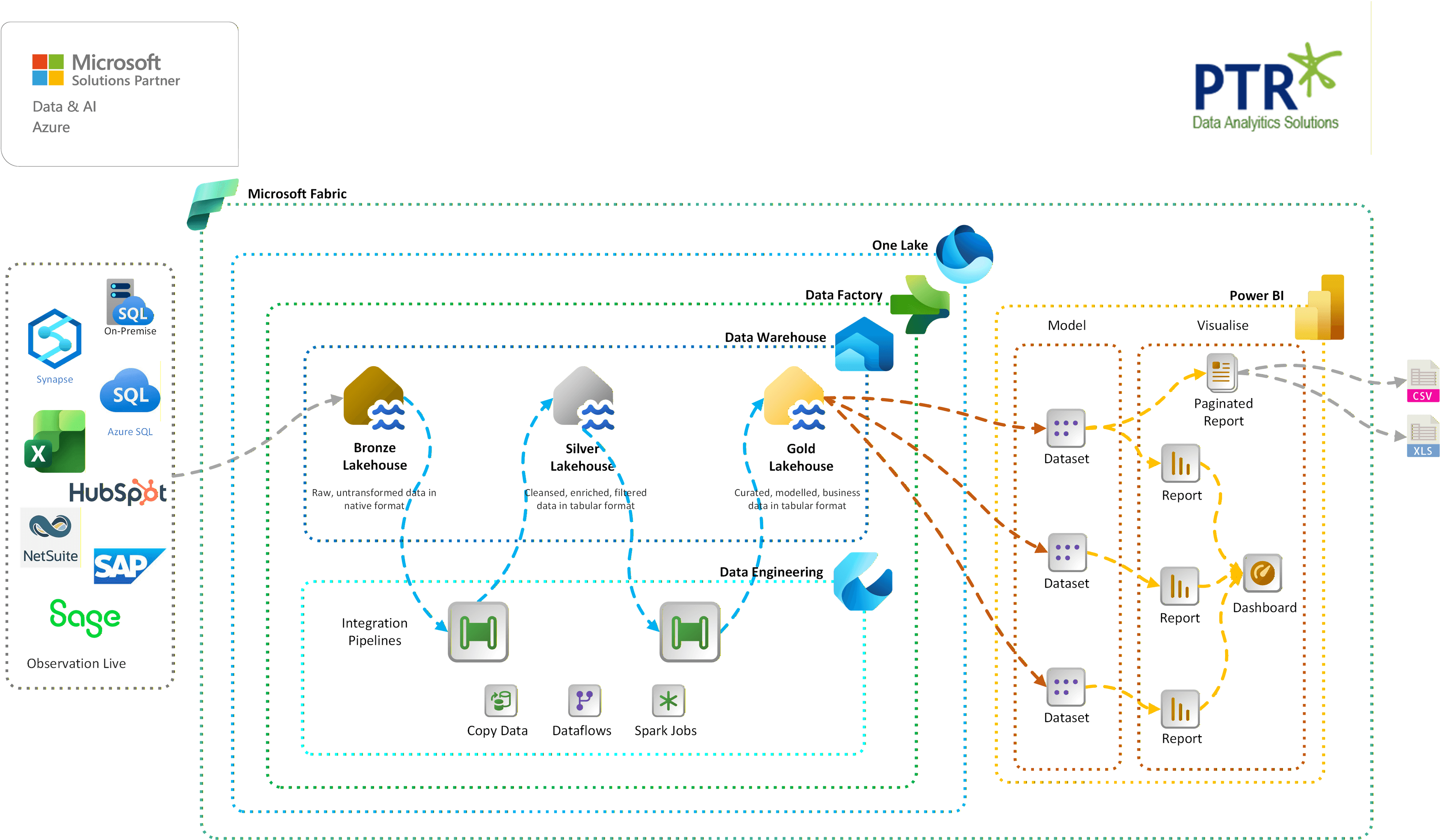
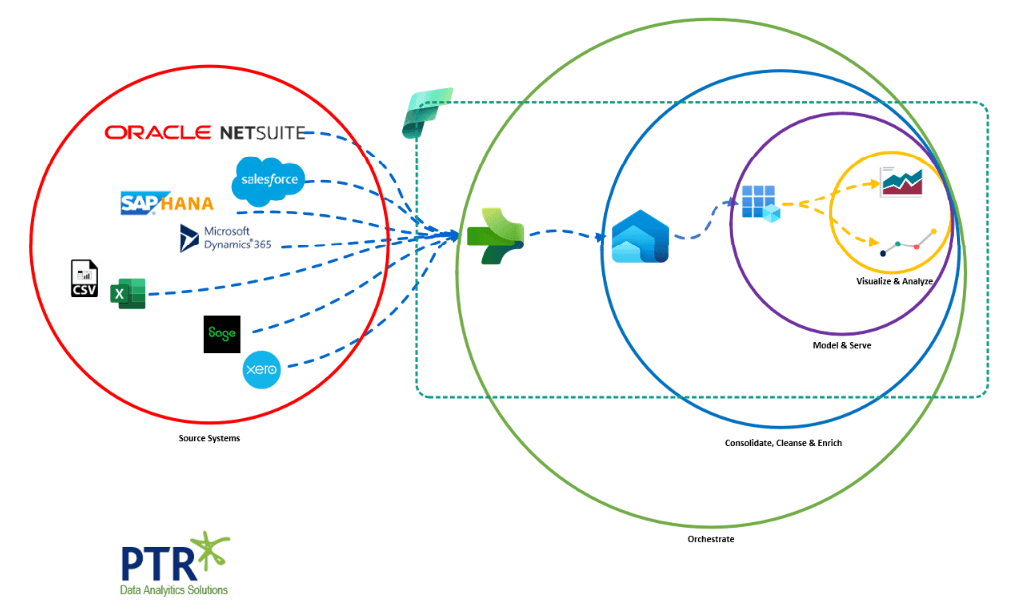
The diagram below shows the layers of the Microsoft Fabric infrastructure - everything from data lake to data warehouse to ELT pipelines to semantic modelling to AI and ML all in one place and working together seamlessly.
Microsoft Fabric was launched November 2023 and we at PTR have been on the Fabric journey from day 1, successfully navigating an emerging data analytics platform as it moved from preview to production release, and migrating clients from
Azure Synapse and
SQL Database infrastructure to Microsoft Fabric.
As with any new infrastructure it has been a journey with a number of hurdles to overcome as the platform developed, but the journey has certainly been worth it, to be able to deliver fully integrated BI solutions to our clients and a much simpler licensing and cost framework. Microsoft Fabric might not be the right choice for you right now, but if you need a little help to determine if you should be considering a move to Fabric in the short or long term you might be interested to hear that we offer a free BI data strategy and platform review service to help you explore how your current data practices can be optimised to better support your organisational goals and take advantage of new trends, platforms and services such as Microsoft Fabric.
Choosing the right data platform depends on your organisation's current needs and future goals. Microsoft Fabric offers a range of features, including:
Unified Analytics Environment: Integrates data engineering, integration, and reporting tools into one platform.
Improved Collaboration: Shared datasets and semantic models enable teams to work together more effectively.
Scalability: Fabric capacities support larger models and high-performance analytics workloads.
Accessibility: Browser-based development eliminates the need for desktop tools, making it easier for teams to adopt.
Not every organisation will immediately benefit from migrating to Fabric. Our
consultancy services include a thorough review of your current data estate, BI components, and future aspirations to determine whether Fabric is the right fit for you.
While Power BI focuses on data visualisation and reporting, Microsoft Fabric extends its capabilities to include data integration, engineering, and governance. Key differences include:
Dataflows and Datasets: Fabric offers automated data collection and transformation processes, along with shared semantic models for multiple reports.
Larger Model Support: Fabric allows for larger models while maintaining accessibility for users with standard Pro licenses.
Browser-Based Development: Unlike Power BI, all aspects of the analytics process in Fabric can be managed directly in the browser.
Microsoft Fabric builds on the strengths of the
Azure Data Platform but introduces new features like OneLake and integrated Power Query within Data Factory pipelines. Key enhancements include:
Unified Data Lake: OneLake provides a common governance layer and makes data accessible across various tools without duplication.
Data Lakehouse: Combines the scalability of a data lake with the performance of a data warehouse, enabling rapid access to data.
Integrated Workflows: Power Query dataflows are now fully integrated within Data Factory pipelines, streamlining data transformation processes.
Transitioning from an Azure-based solution to Microsoft Fabric involves several considerations. While Fabric offers a unified platform, some functionality available in Azure Data Factory, Synapse, and Power BI Premium may not yet be fully replicated in Fabric. This requires careful planning and potentially interim solutions during the migration process.
Key aspects of the migration journey include:
Reviewing Your Current Solution: Assess existing BI components, data sources, and reporting requirements.
Skill Development: Equip your team with the necessary skills to work with Fabric’s new features.
Budgeting and Planning: Understand the costs and timeline for migration to ensure a smooth transition.
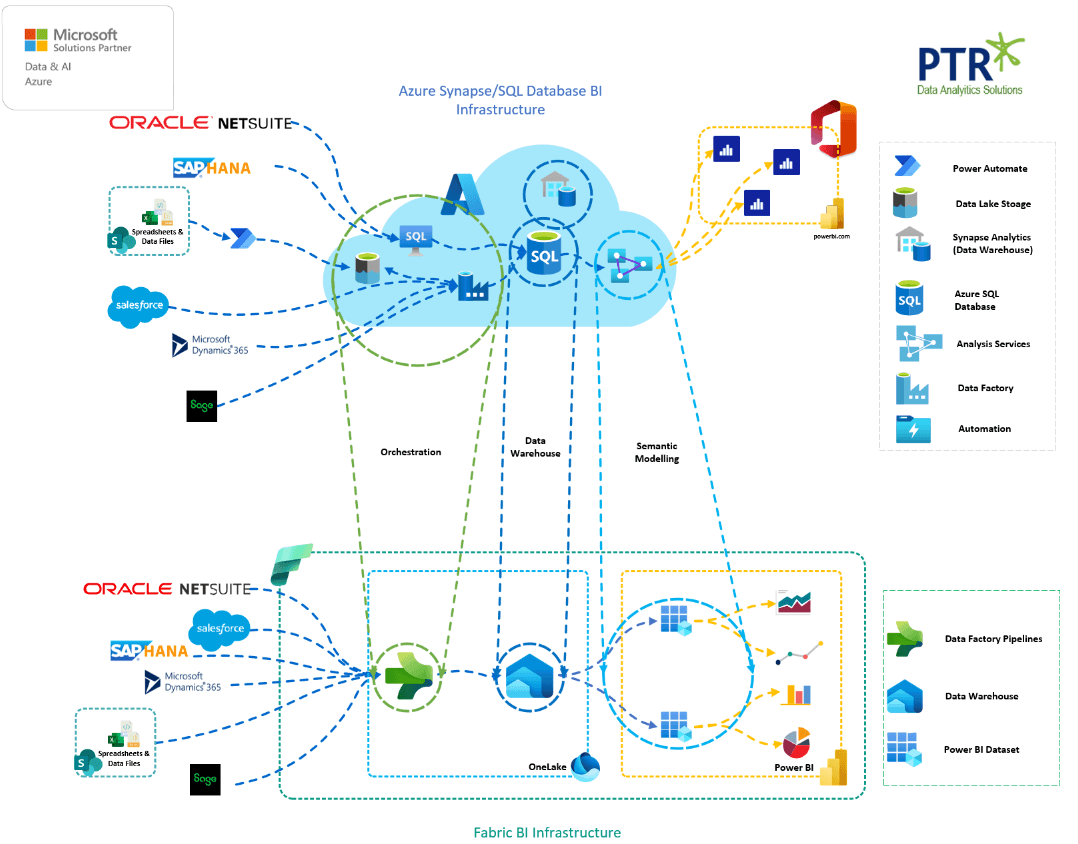
Prior to the launch of Microsoft Fabric in November 2023, multiple data platforms and services were required to deliver a complete data analytics and BI solution - various Azure services for the data lake, data warehouse, ingestion pipelines, AI and ML, and Power BI for semantic modelling and dashboards. But now, you can have all of your data analytics components within one infrastructure.
The following diagram compares Azure Synapse/SQL Database BI Infrastructure with the Microsoft Fabric BI infrastructure:
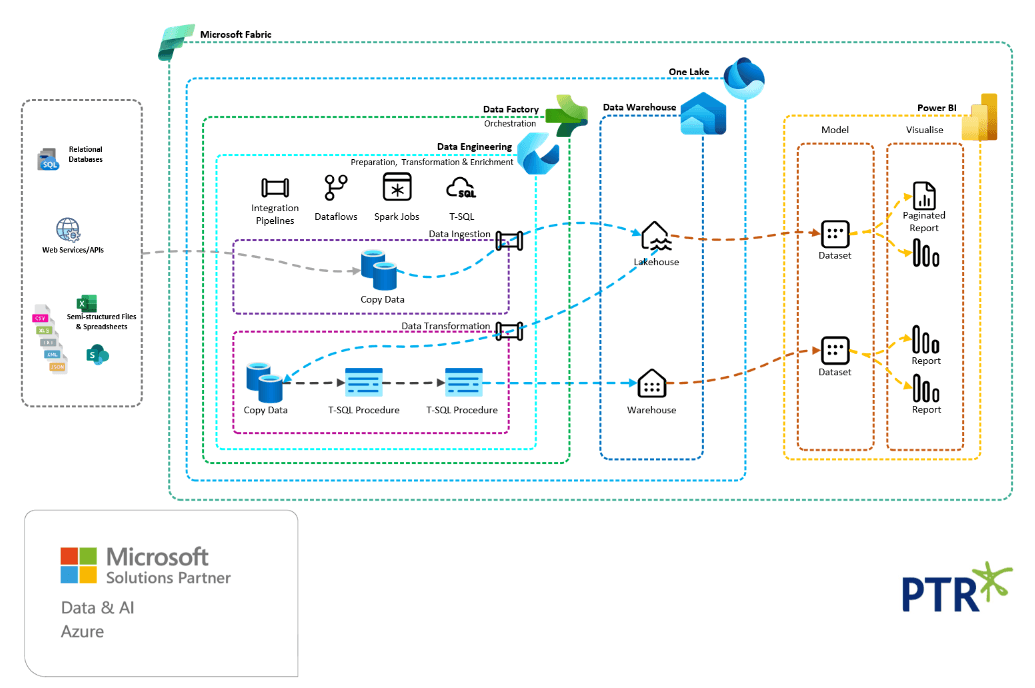
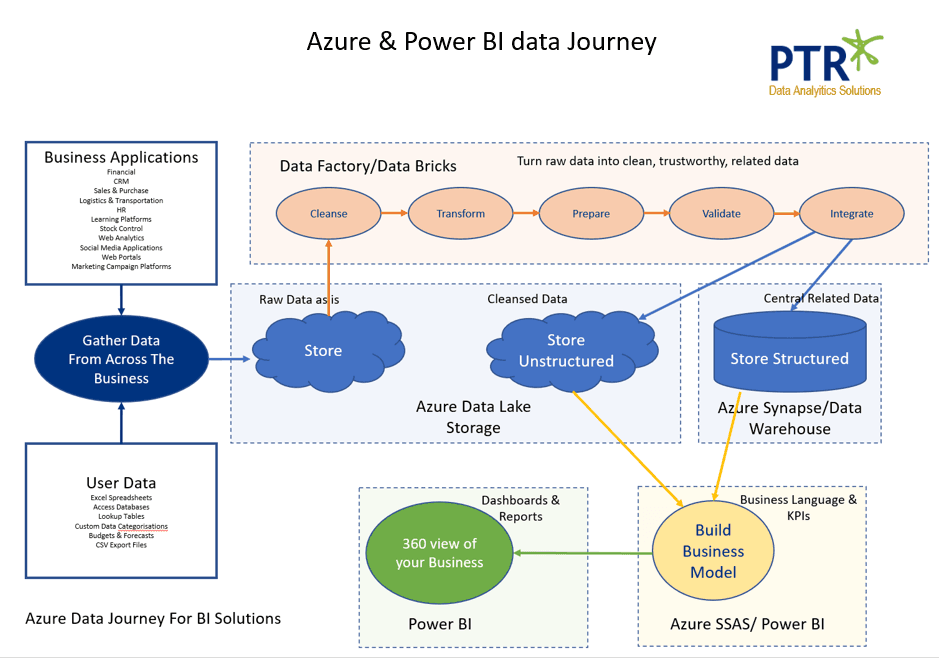
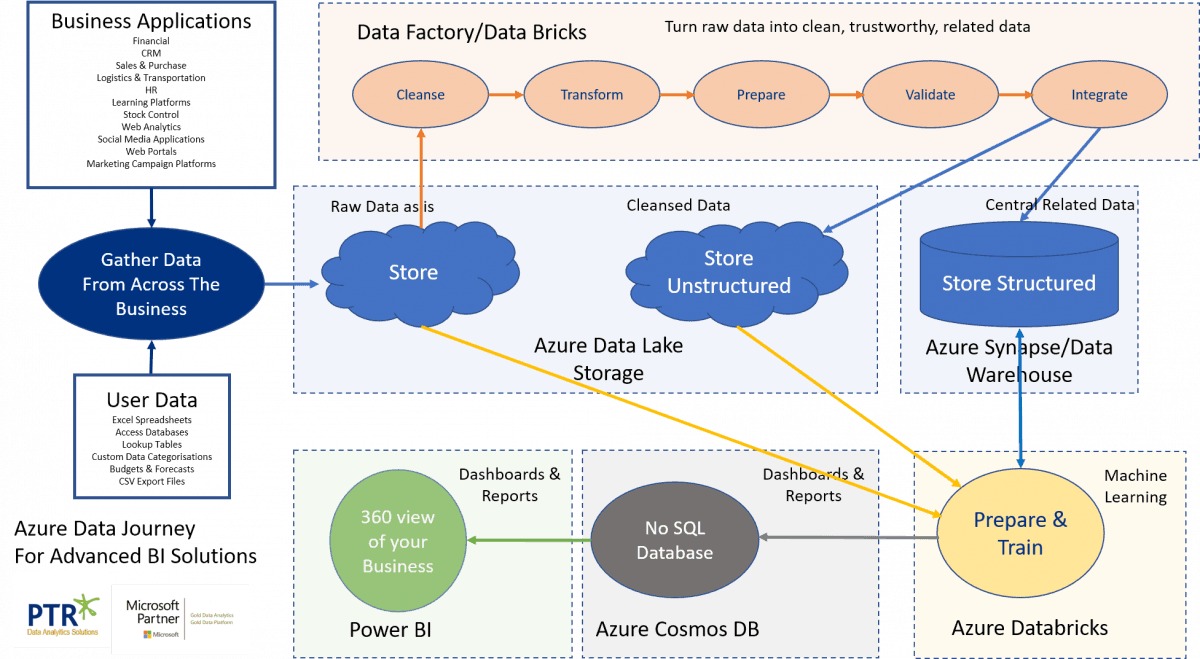
Current Microsoft Azure and Power BI based Data Analytics & BI solutions may look like one of the following high level architectures, or any hybrid of the two.
And across those platform components might be some or all of the following object components:
Power BI Dataflows
Power BI Shared Datasets
Azure SSAS Tabular Models
Power BI Reports
Power BI Paginated Reports
SSRS Reports
Data Warehouse - relational star schema database
Azure Blob Storage Containers
Azure Data Lake Containers
Machine Learning or AI Databricks
Cosmos DB NoSQL Database
Automated and triggered tasks
You may have the traditional Data Warehouse to Tabular Model to Dashboard architecture as above or a more complex Machine Learning, NoSQL DB to dashboard implementation.
Microsoft Fabric supports best-practice
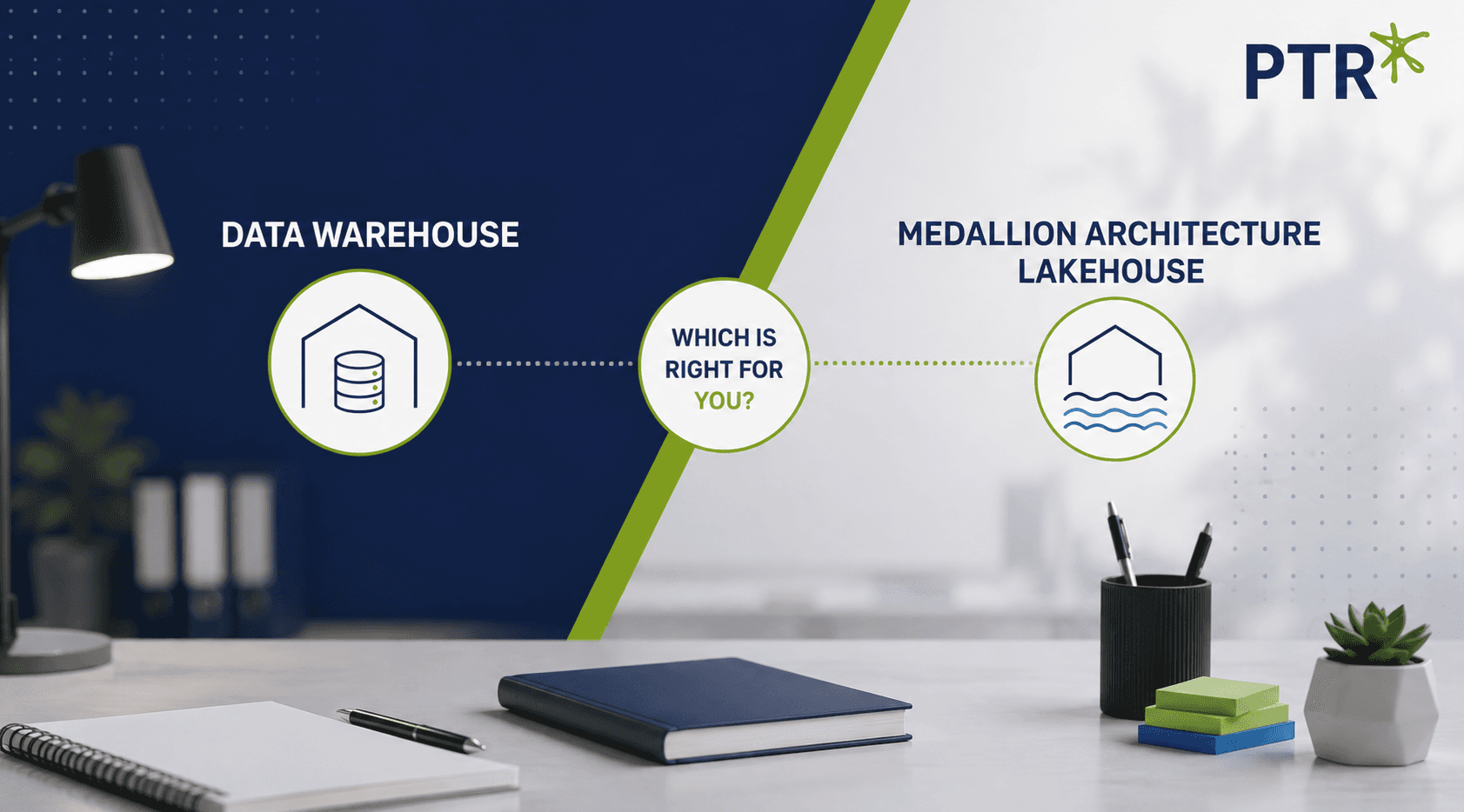
Medallion Architecture design concepts, enabling a layered approach to Lakehouse design with Bronze, Silver and Gold layers to host data at its raw and dirty stage (Bronze), cleansed, transformed & integrated stage (Silver) and curated, quality data stage (Gold).
Medallion design principals result in less movement of data, centralised governance and security, and support for both batch and real-time or near-real-time reporting.
If you’ve already built an Azure-based
single source of truth, with a data lake feeding an enterprise data warehouse and Power BI semantic models on top, you’re in a strong position to move to Fabric.
Your data lake maps naturally onto OneLake, your warehouse can continue as a warehouse within Fabric, and your Power BI models and reports carry across with far less rework than starting from scratch. That gives you two sensible routes. You can move it as is, keeping the same layout with simpler licensing and administration. Or you can use the move to reshape the platform into a
medallion architecture where raw data (Bronze) is cleansed and integrated (Silver) before being curated for reporting (Gold). The “as is” route gets you moving quickly with minimal disruption, while the medallion route adds clearer data lineage, tighter security at each layer and stronger foundations for AI. Neither is right for everyone, which is why we start with a review of your current estate and break the migration into small milestones, so you see visible results early and can choose the path that suits your business.
There is some functionality that you will have enjoyed in the Azure Data Factory, Synapse and Power Premium world that may be a little different in the Fabric world, and this may require some interim handling on your migration journey with a view to switching to new methods as they become available.
Your team may need to acquire some new skills in order to execute the migration work.
Being new it may be a bit of a journey into the unknown with regards to how much a move to the Fabric platform will cost you.
You may not yet need all the benefits that Fabric can bring to a data analytics solution
A new platform will benefit from a complete review of your current solution and future aspirations to ensure that full advantage is taken of the Fabric features and services
Take a look
here for more information on migrating to Microsoft Fabric.
With new platform releases comes the challenge of developing new skills to design, implement and maintain solutions built around these new solution architectures.
Successful adoption of Microsoft Fabric requires expertise across several areas:
Data Integration and Orchestration: Developing pipelines and dataflows using Data Factory, PySpark, and SQL.
Lakehouse Architecture: Designing medallion architectures (Bronze, Silver, Gold layers) and managing governance and security.
Data Warehousing: Creating logical star schemas and optimising queries using Transact-SQL.
Semantic Modelling: Building relationships, hierarchies, and measures using DAX.
Data Visualisation: Developing dashboards, paginated reports, and actionable insights with Power BI.
Data Governance & Security: Implementing Microsoft Purview, managing workspace permissions, enforcing data sensitivity labels, and tracking end-to-end lineage.
At PTR, we take a collaborative approach to help you achieve your data analytics goals. Our consultancy services include:
Strategic Planning: Aligning your data strategy with your organisation’s goals and future aspirations.
Detailed Reviews: Evaluating your existing data estate, BI components, and governance frameworks.
Customised Solutions: Designing and implementing a Microsoft Fabric solution that meets your specific needs.
Skill Development: Providing training and mentoring to ensure your team can effectively use the platform.
With over 35 years of experience and a track record of migrating clients to Microsoft fabric we have the expertise to guide you through your Microsoft Fabric journey.
Migrating to a new platform, or embarking on a new data journey on a new platform, can be daunting. Do you even need to implement a Fabric solution, or is it overkill for you? Our Fabric Consultancy service can help you to assess your requirements and firstly identify what your individual data journey might look like.
Our consultants are all passionate about designing and implementing the perfect solution for our clients and that means that we do not take a "one size fits all" approach. We will work with you to assess what you currently have and where you would like to be. From there we will use the extensive experience across our entire team of consultants and solution architects to come up with the right solution for you.
We often find that it is best to break solution delivery down into smaller Milestones so that you have regular delivery of visible outputs giving early confidence that the solution will satisfy your needs and rapidly making data available for your data driven decision making requirements. Smaller milestones also creates regular touch points that allow a review of the approach - particularly important when embarking on solutions built around new and emerging platforms such as Microsoft Fabric.
Our mentoring approach to working with our clients means that we take you and your team along with us every step of the way on your data journey, ensuring that you can be self sufficient in taking your solution forward once implemented.
While considering your options for a Fabric solution it can be helpful to learn a little more about the platform and architecture choices available to you. Equipping your team with the knowledge and skills they require, and building their confidence to implement a successful BI solution is key to a successful project so you may also want to consider complementing consultancy and mentoring with
training to help you answer the question "Where Do I Start?".
If you’re considering Microsoft Fabric for your organisation or need guidance on migrating from an existing Azure solution, we’re here to help. Contact our team to discuss your requirements and explore how we can support your data analytics goals.