
IT Training
Your Fastest Fabric Quick Win Might Already Be Sitting in Your Team
For people who already have SQL skills, Microsoft Fabric is not a foreign country. It is a familiar road with a much better car.

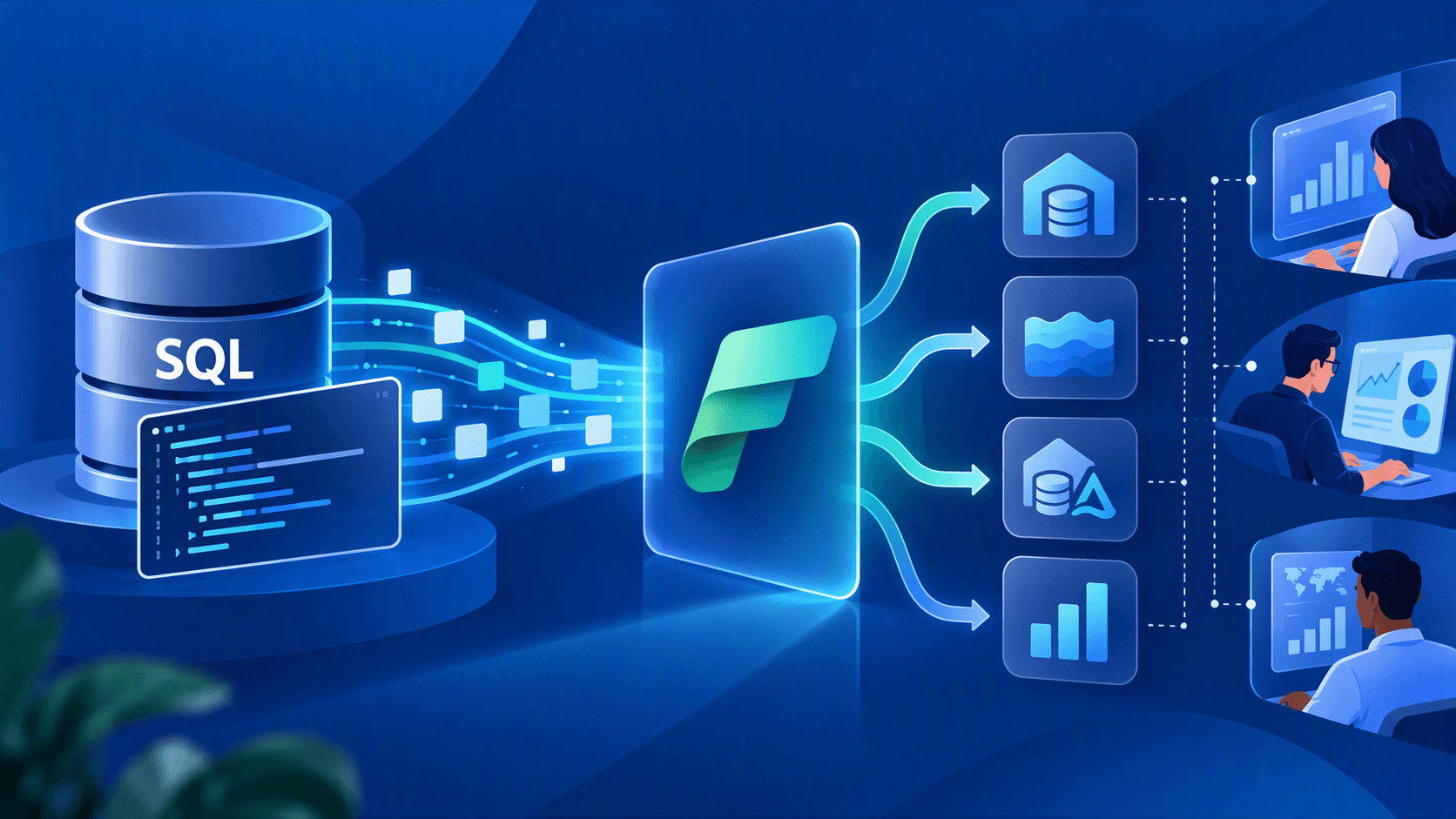
When organisations talk about adopting Microsoft Fabric, the conversation usually starts with technology: licences, capacity, architecture diagrams and migration plans. But the question that really decides whether adoption succeeds is much simpler.
Can your people actually use it?
Many leadership teams assume the honest answer is "not yet". Fabric is new, the reasoning goes, so everyone must need retraining from scratch. That assumption quietly becomes one of the biggest adoption blockers of all. Budgets balloon, timelines stretch, and staff brace themselves for a steep learning curve that, for many of them, simply isn't there.
Same pedals, new car
Think about the last time your car was replaced. The dashboard looked different, the infotainment screen had a dozen new features, and it took a few days to figure out what all the buttons did. But you didn't have go and have more driving lessons. The pedals, the steering wheel and the rules of the road were exactly the same.
Moving to Microsoft Fabric is much the same for anyone who already knows SQL, the language used to ask questions of data for decades. Fabric looks new on the surface, but much of it can be queried with SQL underneath.
The Warehouse speaks it, Lakehouse data can be queried with it, and databases mirrored into Fabric can be explored with it.
For people who already have SQL skills, Microsoft Fabric is not a foreign country. It is a familiar road with a much better car.
The quick win hiding in plain sight
This is why a SQL skills audit is often one of the fastest quick wins in any Fabric programme. Most organisations have more SQL capability than leadership realises. It sits with the analyst in finance who has been quietly pulling month-end figures for years, the operations manager who learnt it at a previous job, and the IT team who have maintained your databases all along.
It is like planning a business trip to Paris and discovering that someone in accounts speaks fluent French. You did not need to hire a translator. You just needed to ask around.
Identifying and deploying these existing skills means you can start getting value from Fabric in weeks rather than months, building early successes that give the wider programme momentum.
When the skills gap becomes the blocker
The flip side is just as important. Where SQL skills are thin or missing, adoption stalls in predictable ways:
- The Unused Gym Membership: The licences are paid for, the platform is ready, and the capability is impressive. But without the skills to use it, Fabric sits there like a gym membership in February. It is a monthly cost with very little to show for it.
- The Phrasebook Problem: When business teams cannot ask their own questions of the data, every request has to be translated by a small group of technical specialists. It is like travelling abroad with one colleague who speaks the language. Every order, every direction and every question goes through them, and the queue never gets shorter.
- The Portable Heater Habit: When people cannot get what they need from the new platform, they fall back on exporting data into spreadsheets and building their own versions. It is like installing central heating and then carrying a portable heater from room to room. The investment is there, but old habits carry on, and so do the personal data silos Fabric was meant to remove.
- The Sat Nav Blind Spot: AI tools can now draft SQL queries in seconds, which leads some leaders to ask whether anyone needs to learn it at all. But a sat nav does not remove the need to know how to drive. Someone still has to notice when it is cheerfully directing you into a ford. Without SQL literacy, nobody on the team can spot when an AI-generated query has double-counted revenue or quietly dropped half your customers. SQL skills are what make AI output trustworthy.
Right-sized training, not retraining everyone
The good news is that closing the gap does not mean sending the whole organisation on a lengthy course. Think of it like car ownership. Most people just need to drive. Some need to check the oil and tyre pressures. Only a few need to take the engine apart.
The same applies to SQL. Report users benefit from understanding what a query is doing. Analysts gain real independence from writing their own. Data engineers need deeper scripting skills to automate transformations and keep the platform running smoothly. Matching the depth of training to each role keeps costs down and gets people productive faster.
At PTR, our SQL training pathway is built around exactly this progression. It starts with our Introduction to SQL course, or SQL for Data Analysts for those focused on analysis, and moves through Advanced SQL to Transact SQL programming for those who need to automate complex data work.
Every course can be delivered face to face or virtually, and tailored to your own systems and data. Combined with our consultancy services, this means we can help you find the skills you already have, fill the gaps that matter, and leave your team confident and in control of your Fabric platform.
Just one blocker, just one quick win
SQL skills are only one example of an adoption blocker that can be turned into a quick win with the right support. Most Fabric programmes meet several: skills gaps, resistance to change, governance worries, and uncertainty about where to start.
In our upcoming webinar, Microsoft Fabric — Navigating Adoption Blockers and Identifying Quick Wins, we will explore the most common roadblocks we see in organisations adopting Microsoft Fabric and show you how to spot the opportunities you can act on straight away, without waiting for a perfect, multi-year plan.
7th October 2026 (Virtual) — Register here.
MD
Mandy Doward
Managing Director
PTR’s owner and Managing Director is a Microsoft certified Business Intelligence (BI) Consultant, with over 35 years of experience working with data analytics and BI.


Frequently Asked Questions
Couldn’t find the answer you were looking for? Feel free to reach out to us! Our team of experts is here to help.
Contact Us