Tech Tips
What is a Data Platform Health Check?
What a Data Platform Health Check assesses, what it deliberately is not, and how a focused Data Governance engagement follows when it finds gaps. It runs over weeks rather than months, with no redesign required.

AI agents and tools like Copilot read from and write to your Fabric environment with whatever access and definitions it already has. A Data Platform Health Check is a short, assessment-only review that tells you whether that foundation is ready. This article explains the business risk of skipping the check, what the Health Check examines, what it deliberately does not do, what you get from it, and how a focused Data Governance engagement follows if gaps turn up.
The business risk of skipping it
Many organisations cannot say quickly who can see what, whose definition of a key figure is the right one, or whether duplicated pipelines are quietly adding cost. That uncertainty is manageable while people build slowly. It becomes expensive when AI tools start reading and writing at speed, because the tools inherit the same uncertainty and repeat it across everything they touch. The result is conflicting numbers, access that is wider than anyone intended, and AI projects that stall because nobody trusts the base. Typical warning signs are a pilot that produced impressive demos and then disappointing answers, or a Microsoft 365 Copilot rollout that raises quiet worries about what it might surface from shared drives and old SharePoint sites.
What gets assessed
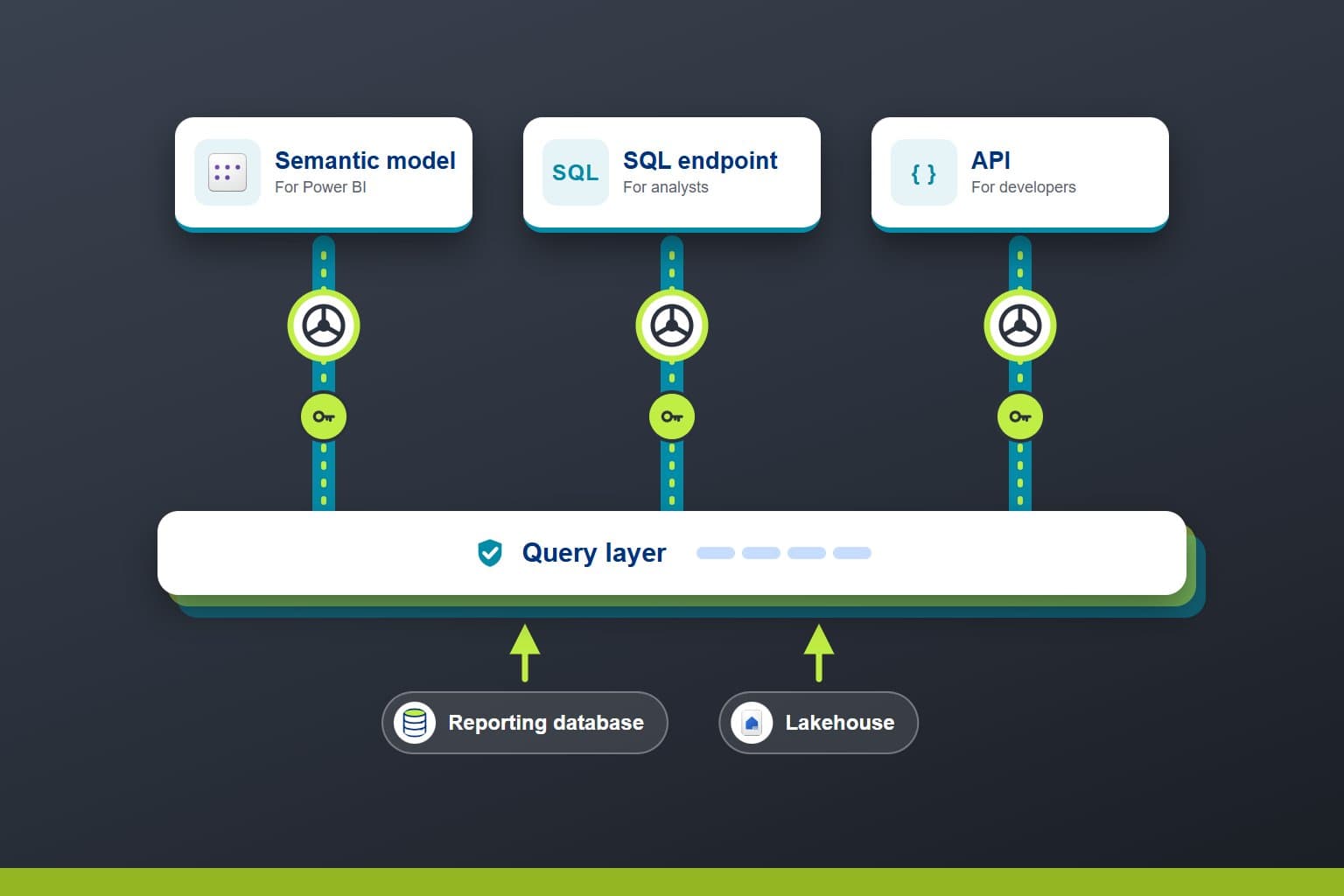
A Health Check looks at four things in particular. Governed access comes first - whether your security model is actually one consistent set of rules at table, row and column level, or a patchwork that happens to work for the reports currently in use. Platform health is next - capacity sizing, duplicated pipelines, and whether refresh patterns match what the data actually needs, rather than what got built under time pressure. Semantic model clarity matters just as much - whether your key metrics have a single, documented definition an agent (or a new starter) could build from without guessing. And governance posture closes it out - whether sensitivity labelling and lineage are actually tracked, or exist in theory but nobody’s checked recently.
What it isn’t
It isn’t a redesign, and it isn’t scoped like one. The engagement is short and assessment-only - weeks, not months - and the output is a clear picture of what’s already solid against what needs attention, not a mandate to rebuild. Most organisations find most of their foundation is fine; a Health Check exists to find the specific gaps worth fixing before they get inherited by something faster than a person.
How it fits with the AI Readiness Assessment
A Health Check concentrates on the platform and its governance. If you want a wider view measured against the AI use cases you have in mind, PTR’s AI Readiness Assessment covers your data, platform, governance and people. It typically takes three to five days and ends with a clear picture of where you stand, technical recommendations and a roadmap that is yours to keep. A free one-hour discovery workshop helps agree which is the right size of review for you.
What you gain
- A clear picture. You know what is solid and what needs attention, in plain terms, before AI is given real work.
- Targeted fixes. Effort goes to the specific gaps found, with no rebuild of what already works.
- Confidence to proceed. Leaders can approve AI projects knowing the foundation has been checked.
- Lower risk. Access, definitions and lineage problems are found by you first, rather than by an agent.
Where gaps turn into work
Where it does turn something up - inconsistent access rules, undocumented metrics, missing classification - a focused Data Governance engagement is the next step, not a return to the Health Check. That’s where OneLake Security gets defined as one model rather than several, Purview classification and lineage get put in place properly, and the access rules an agent would inherit get reviewed and tightened rather than assumed. It’s deliberately a separate, smaller step from a full platform consultancy engagement, because most of what a Health Check finds doesn’t need one.
PTR’s Data Quality & Governance service covers quality checks that catch problems early, and Microsoft Purview policies that control who, and what, can see your data, so that AI assistants never surface content they shouldn’t.
The part training doesn’t replace
A sound foundation and a trained reviewer solve different problems, and you need both - a governed platform with nobody able to judge what’s built on it is still a risk, just a different one. That’s why PTR pairs this work with training, which we cover in The Skill Nobody’s Trained For Yet: Reviewing What AI Builds.
Related reading
For the technical background, see Before You Let AI Build on Your Data, Check What It’s Building On. For the business view of the same risk, see Hiring a Brilliant New Starter. To see a governed foundation paying off, read the housing association case study, Built on Solid Ground. PTR’s AI Readiness & Data Foundations page covers the wider set of services.
Next steps
If you’re not sure whether your own Fabric environment would hold up to an agent reading from or writing to it, a Data Platform Health Check is the place to start. Contact the PTR team through our enquiries page, by email at info@ptr.co.uk, or on 0118 979 4000.
MD
Mandy Doward
Managing Director
PTR’s owner and Managing Director is a Microsoft certified Business Intelligence (BI) Consultant, with over 35 years of experience working with data analytics and BI.
Frequently Asked Questions
Couldn’t find the answer you were looking for? Feel free to reach out to us! Our team of experts is here to help.
Contact Us