Technology
Before You Let AI Build on Your Data, Check What It’s Building On
Fabric Data Agents, Fabric Apps and agentic data engineering are here. Agents reproduce whatever is already true of your data and access model, so a governed foundation, a spec, a decision log and a reviewed plan matter before they get real work.

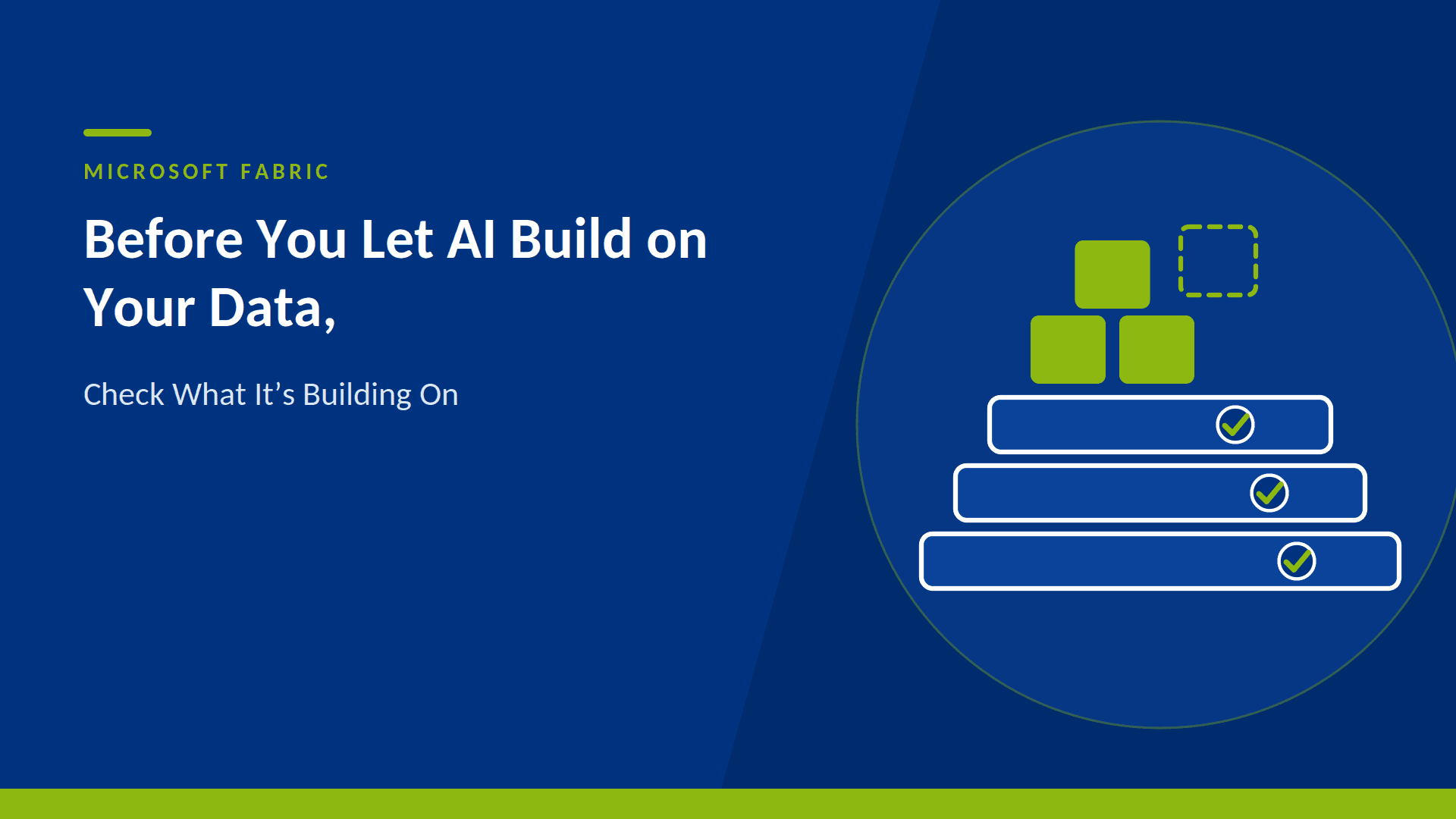
AI agents inside Microsoft Fabric can now plan, build and run data engineering work, not just answer questions about your data. This article is for data and BI practitioners. It explains what has changed, why an agent reproduces whatever state your data and access model are already in, and what a governed foundation needs before you give an agent real work: governed access, a documented spec, a decision log and a reviewed plan.
If you are reading from the business side, our companion piece Hiring a Brilliant New Starter covers the same ground without the technical detail.
What has changed in Fabric
A year ago, “AI and your data” mostly meant better dashboards - ask a question, get an answer, move faster. Microsoft’s recent Fabric updates make governed enterprise data directly usable by AI agents and applications. Agentic data engineering features can plan, execute and validate data engineering work within boundaries set by engineers. Fabric Apps builds application development directly onto governed Fabric data. Fabric Data Agents - domain-specific agents that inherit Fabric’s existing security, compliance and auditing controls - reached general availability this autumn.
Fast agents building on your data can be a genuine quick win. Whether they are depends entirely on what they’re building on.
Agents inherit what’s already there
We’ve written about this risk from the engineering side in our piece on spec-driven development: without a fixed reference point, an AI assistant doesn’t stop at what you asked for - it keeps building. Left unchecked, that shows up as scope drift, where each prompt moves the solution a little further from the brief, code drift, where conventions change from one session to the next, a growing pile of “just fix this one thing” prompts, and infrastructure sized for whatever the assistant decided to build rather than what the job needed.
The remedy mirrors the principle behind OneLake. Fabric keeps one copy of the data that everything draws on, and the same idea applies to the build: one trusted specification that everything else is checked against.
Why it matters: an agent that can plan and execute its own data engineering work will reproduce whatever is already true of your data and access model, governed or not, considerably faster than a person would. Centrica’s Finance team saw the upside of this when they connected Fabric Shortcuts across their existing ERP, billing and CRM systems without migrating or duplicating anything - the foundation they built on was already sound, so the thing that scaled was the win, not the mess.
The foundation an agent reads from
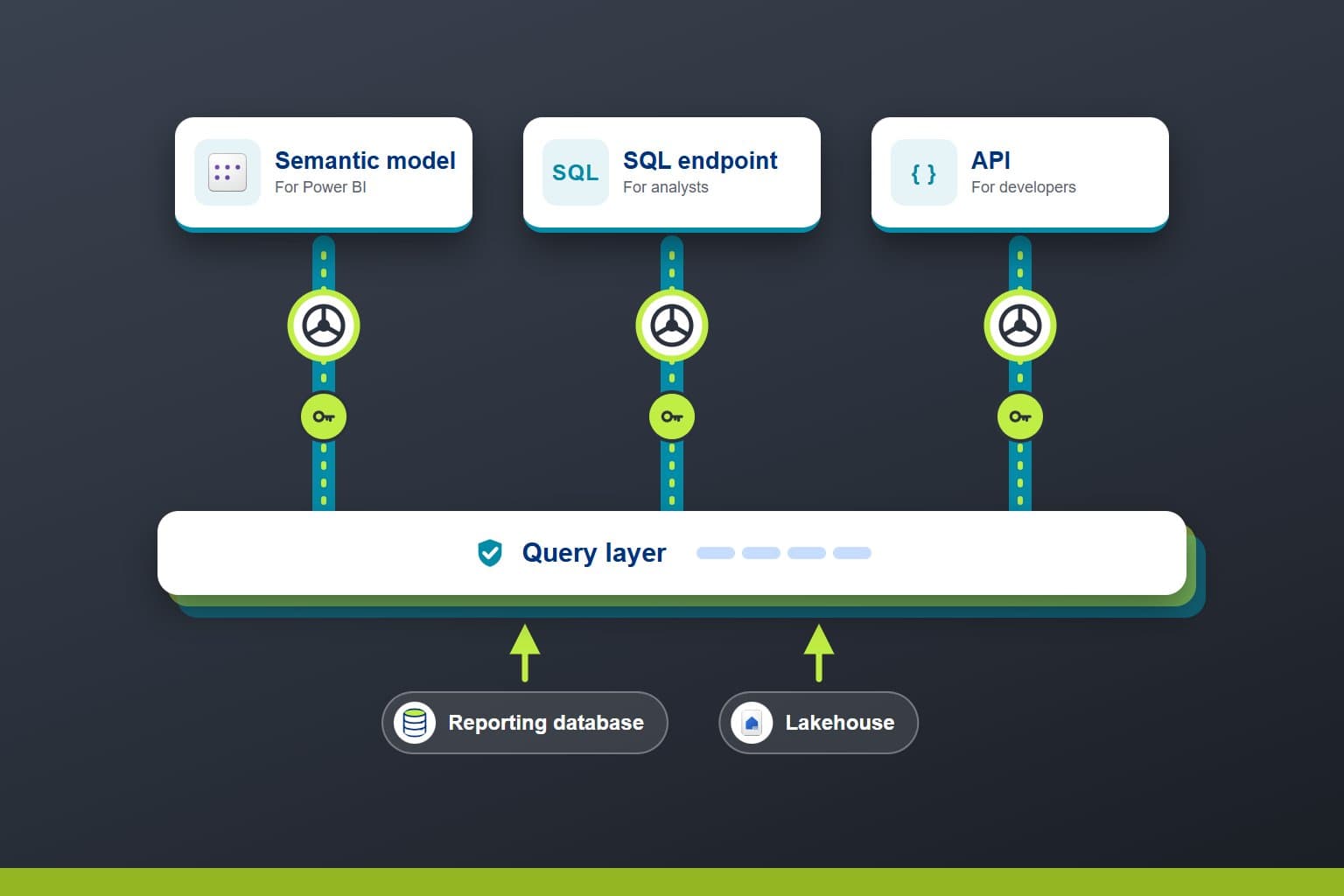
The same logic applies to what an agent is reading, not just what it’s writing. Microsoft’s own guidance here is direct: Copilot and AI agents are only as reliable as the governed data and semantic models they’re grounded in, and tools like Purview exist specifically to show what an agent can see and act on. A well-curated, governed data model is what decides whether an agent’s answer can be trusted - not how capable the agent itself is.
Agents also need to know what the data means. PTR’s AI Readiness & Data Foundations work treats a shared understanding of business concepts such as a customer, an order or an asset, and the rules that apply to each, as essential once agents act rather than just answer. That shared understanding is called an ontology. With Fabric IQ it can be modelled over your data in OneLake and made available to agents, including through the Model Context Protocol (MCP), an open standard that lets compatible AI tools discover and use your data in a governed way.
Think of it like handing someone a toolbox to renovate a room in a house where nobody’s checked the wiring behind the wall. The tools were never the issue - what’s behind the wall is.
What a governed foundation actually requires
In practice this isn’t a new checklist - it’s the same discipline a good human-built project already needs, just no longer optional once an agent is involved.
- Governed access. One security model - table, row and column-level - enforced the same way whatever route the data came in by, so an agent inherits consistent rules rather than a patchwork.
- A documented spec. What the solution must do, how each metric is defined, and what “done” looks like, so an agent has a fixed target rather than a drifting conversation to follow.
- A decision log. A record of what changed and why, so six months from now nobody has to reconstruct a judgement call from memory - including the agent’s own.
- A reviewed plan before anything is built. A person who actually understands Fabric, DAX and SQL checking the proposal, not simply approving it.
Where to start
If you’re not sure whether your own foundation would hold up, PTR offers two ways to find out. A Data Platform Health Check, explained in What a Data Platform Health Check Actually Checks, is a short, scoped look at your governance, access model and platform health. The AI Readiness Assessment goes wider, looking at your data, platform, governance and people against the AI use cases you actually want to run, and typically takes three to five days.
The assessment answers six questions. Is your data integrated, accurate and kept up to date? Do your key business terms and metrics have an agreed definition? Is your data governed so that AI sees only what it should? Can AI tools reach your data safely? Which use cases are worth pursuing? Are your people ready, or is there a skills gap? You finish with a clear picture of where you stand, technical recommendations and a roadmap that is yours to keep. The findings hold whichever AI tools you choose, because the assessment is independent of any one of them.
Where either turns up real gaps, PTR’s Data Quality & Governance service is the next step.
Related reading
The people reviewing AI-built work need specific skills, which we cover in The Skill Nobody’s Trained For Yet: Reviewing What AI Builds. For the engineering detail on keeping AI-assisted builds on brief, read Spec-Driven Development for Data & BI on Microsoft Fabric and Azure. PTR’s AI Readiness & Data Foundations page sets out the full range of related services.
Next steps
PTR combines Microsoft Fabric and Azure consultancy with training, so the people reviewing AI-built work are equipped to judge it properly. A free one-hour discovery workshop is the easiest way to agree the right size of assessment for you. Contact the PTR team through our enquiries page, by email at info@ptr.co.uk, or on 0118 979 4000.
MD
Mandy Doward
Managing Director
PTR’s owner and Managing Director is a Microsoft certified Business Intelligence (BI) Consultant, with over 35 years of experience working with data analytics and BI.
Frequently Asked Questions
Couldn’t find the answer you were looking for? Feel free to reach out to us! Our team of experts is here to help.
Contact Us